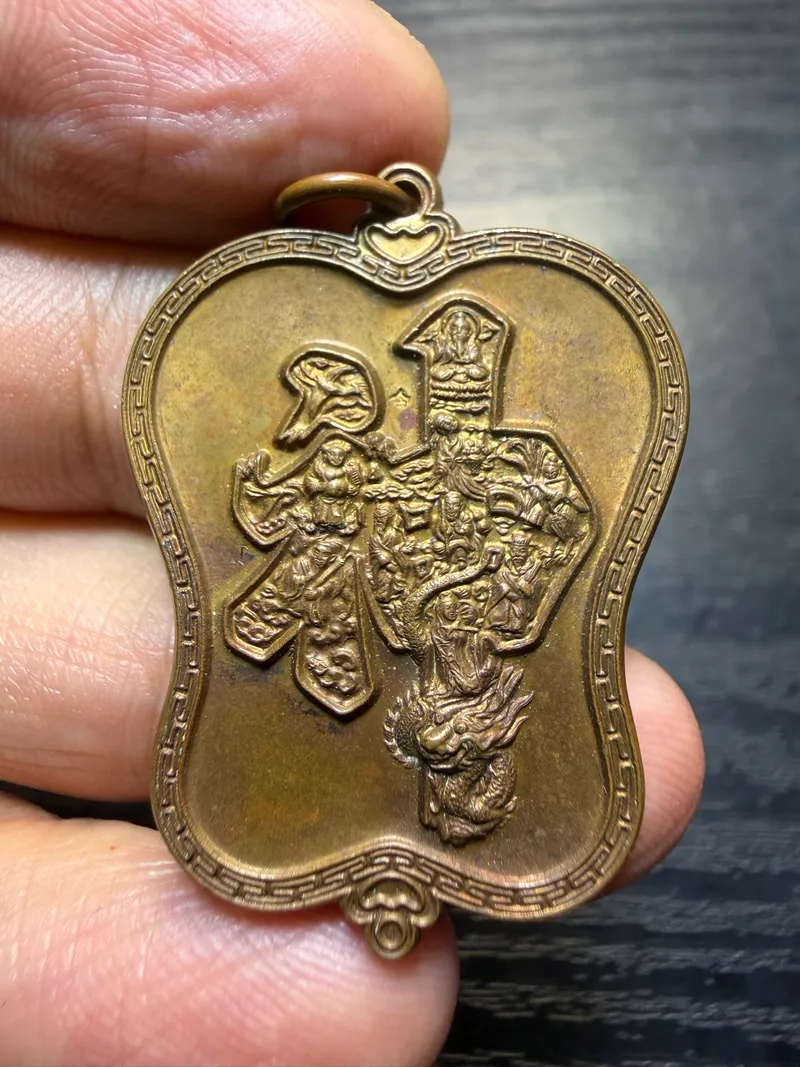
Luang Pho Yit's "Shen" (神, "deity") Eight Immortals fan medal from Wat Chulamani, Samut Songkhram, B.E. 2545 (2002), listed by the supplier as the first batch. It blends Taoist imagery with a Thai amulet: a palm-leaf fan shape with a large Chinese character 神 on the front, inside whose strokes Taishang Laojun, the Eight Immortals and a coiled dragon are hidden. The back is cast in Chinese with the names of the Four Heavenly Kings, the blessings "turn misfortune into luck" and "peace under heaven", a bagua yantra at the centre and the temple name 朱拉嗎呢寺 (Wat Chulamani) at the foot. Judged genuine by the Thai Buddha Image Admiration Association, No. 03484; the formal certificate is included. One piece only; it is held by a partner supplier, so please submit a request and we confirm availability by email within 24 hours.
What is Luang Pho Yit's Eight Immortals fan medal (เหรียญหลวงพ่ออิฐ วัดจุฬามณี)?
This copper medal was made at Wat Chulamani (วัดจุฬามณี), Samut Songkhram, for Chinese devotees. Its shape follows the palm-leaf fan used in Taoist rituals, said to "sweep away a thousand misfortunes and bring in a hundred blessings". On the front, the character 神 ("deity") hides Taishang Laojun, the founding figure of Taoism, and the Eight Immortals, who in Chinese custom stand for celebration and good fortune. The back carries the names of the Four Heavenly Kings, which together mean "favourable wind and rain". According to the supplier, Luang Pho Yit made it to raise funds for building the temple, and this is the first batch.
Key facts
- Type: fan-shaped copper medal; character 神 on the front with Taishang Laojun and the Eight Immortals, Four Heavenly Kings and bagua yantra on the back
- Batch: first batch (per the supplier)
- Material: copper (per the supplier, cast with old Chinese coins and sacred yantra metal sheets)
- Temple: Wat Chulamani (วัดจุฬามณี), Samut Songkhram Province; the back is cast with the temple name 朱拉嗎呢寺
- Master: Luang Pho Yit (หลวงพ่ออิฐ), abbot of the temple according to the supplier, who made and consecrated it himself
- Year: B.E. 2545 (2002, per the supplier)
- Certification: judged genuine (แท้) by the Thai Buddha Image Admiration Association, No. 03484, barcode GJ10-23A2F, dated 13 October B.E. 2569 (2026); the formal certificate is included
- Stock: one piece only, held by a partner supplier
Luang Pho Yit and Wat Chulamani
Wat Chulamani, near Amphawa in Samut Songkhram, is one of the busiest temples in the province. Luang Pho Yit (หลวงพ่ออิฐ) leads the temple, and his amulets are popular with Thai and Chinese collectors alike, his Thao Wessuwan medals above all. According to the supplier, he made and consecrated this fan medal himself, with the proceeds going to temple construction.
Blessings
- Wealth: the Eight Immortals bring good fortune; the supplier says it supports income and business
- Popularity and luck: the yantra script on the back is for popularity and good luck
- Protection: the bagua yantra and "turn misfortune into luck" are for warding off danger and evil
- Wishes: the supplier relays the master's words that the fan medal helps wishes come true, and is also said to help recover lost things
Please note: an amulet supports your own efforts and intentions; it does not guarantee any outcome. Keeping the Five Precepts is traditionally encouraged.
Craftsmanship
A palm-leaf fan outline framed by a Greek-key border, with a loop at the top. The character 神 stands in high relief, its strokes filled with recognisable Taoist figures, with a dragon coiled at its base. On the back, vertical Chinese inscriptions name the Four Heavenly Kings of the east, south, west and north, alongside "逢凶化吉" (turn misfortune into luck) and "天下太平" (peace under heaven). A bagua and yin-yang yantra ringed with Thai script sits at the top, yantra symbols and Thai letters fill the middle, and "朱拉嗎呢寺" runs along the bottom. The copper has an even antique-bronze tone with crisp lettering.
FAQ
Q: Why would a Thai temple make a Taoist-themed amulet?
A: Samut Songkhram has a large Chinese community, and temples there often make pieces with Chinese script and Taoist deities for Chinese devotees. This one is cast on the back with the temple's Chinese name, 朱拉嗎呢寺, which ties it to Wat Chulamani.
Q: What is the yellow card in the photos, and which card do I receive?
A: The yellow card is the Thai Buddha Image Admiration Association's authentication receipt, issued on the spot once a piece is judged genuine; the formal certificate is collected on the Thursday of the following week. This piece's yellow card is No. 03484, marked "แท้" (genuine), with the "มีซ่อม" (repaired) box left blank, dated 13 October B.E. 2569 (2026). The buyer receives the association's formal certificate.
Q: What do the Four Heavenly Kings stand for?
A: The King of the East holds a sword for "wind", the King of the South an umbrella for "rain", the King of the West a serpent for "smooth", and the King of the North a pipa lute for "harmony". Together they spell "favourable wind and rain": good harvests and a peaceful land.
Q: Can I wear a copper medal every day?
A: Yes. A case is recommended to avoid scratches. Do not scrub it with cleaners; the original tone is part of its proof of age.
Q: Who is it suited to?
A: Business owners, anyone hoping for a thriving career, frequent travellers, and collectors who like Taoist and Chinese-themed pieces.
Q: Why do I request first and pay later?
A: This piece is held by a partner supplier rather than in our Bangkok stock. So that nobody pays for a piece that has already gone, we confirm with the supplier first and reply by email within 24 hours. If it is available, the email includes a payment link valid for 24 hours. Submitting a request costs nothing.
About this piece
- Includes: the medal (uncased) and the Thai Buddha Image Admiration Association formal certificate (No. 03484)
- Price: ฿7,000
- Stock: one piece only
- How to buy: submit a request on this page; pay through the emailed link once availability is confirmed
Last updated: 2026-10-29 | Merit Messenger team (Bangkok-based)