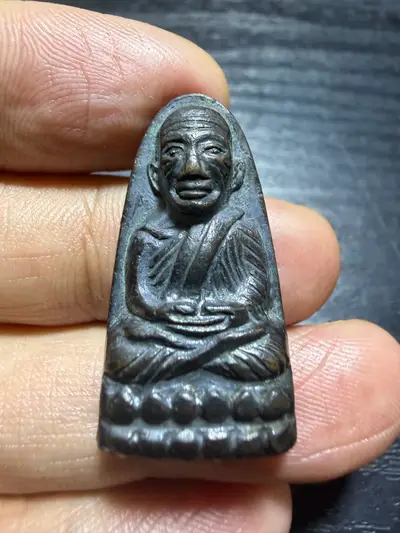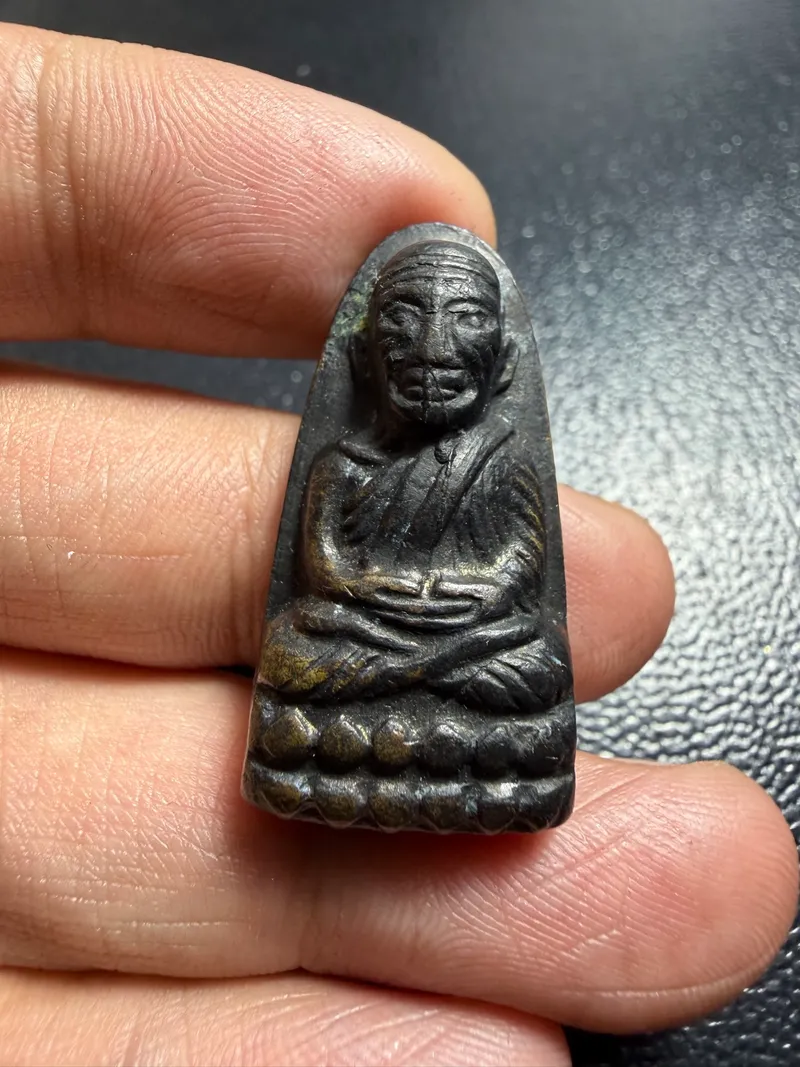
Luang Phor Thuad lang nangsue lek, small script back (พระหลวงพ่อทวด หลังหนังสือเล็ก เนื้อโลหะ), metal, B.E. 2505 (1962), registered to Wat Chang Hai (วัดราษฎร์บูรณะ (วัดช้างให้)), Pattani. Certificate GJ06-98E42. One piece only. It is held by a partner supplier, so please tap Hold this piece for me and we confirm availability by email within 24 hours.
What is a Luang Phor Thuad lang nangsue lek?
Luang Phor Thuad (หลวงปู่ทวด, also written หลวงพ่อทวด) is the legendary monk of southern Thailand, said to have lived in the Ayutthaya period and best known for the story of turning seawater fresh by stepping into it. Wat Chang Hai (วัดช้างให้) in Pattani is the temple that enshrines him. From B.E. 2497 its abbot, Phra Ajarn Tim Thammatharo (พระอาจารย์ทิม ธมฺมธโร), made a series of amulets bearing his image, and they became the best-known protective amulets in Thailand. Lang nangsue (หลังหนังสือ) means lettering on the back: the version whose reverse carries script and the temple name. The outline, narrow at the top with a straight base, is what Thais call the flat-iron shape (เตารีด).
The Association website records this piece as พระหลวงพ่อทวด หลังหนังสือเล็ก เนื้อโลหะ พ.ศ. 2505: Luang Phor Thuad, small script-back mould, metal, B.E. 2505, from Wat Chang Hai in Pattani, which agrees with the supplier on the year. The record gives the temple as วัดราษฎร์บูรณะ (วัดช้างให้): วัดราษฎร์บูรณะ is the formal name of Wat Chang Hai, while the back of the piece carries the everyday name, วัดช้างให้. Lek (เล็ก) means small, the smaller mould of this version. The material line says only เนื้อโลหะ, metal, without naming the alloy, and this page follows it. Two points in the supplier's title are not on the record. One is the description original skin, fine condition, meaning the surface it left the temple with. The other is a mould name; the record says small mould and nothing finer, so this page does not treat it as fact. The product photo shows the Association's yellow slip, ticked แท้ (genuine), with the number first miswritten, struck out and rewritten as 09816, the name handwritten as ปู่ทวด 05 and the date 23 มิ.ย. 2569, and the sealed box, whose barcode reads GJ06-98E42. The supplier adds that this version was made under Phra Ajarn Tim; the record names no person. The supplier's copy also says that wearers of Luang Phor Thuad almost never die in road accidents and that the amulet protects better than an airbag. Those lines have no source and are not used here.
Key facts
- Type: Luang Phor Thuad figure, small script-back mould (หลังหนังสือเล็ก), flat-iron shape, no lug
- Cast on the back: three lines of Khom script, then หลวงพ่อทวด วัดช้างให้
- Material: metal (เนื้อโลหะ), alloy not specified on the record; black surface
- Year: B.E. 2505 (1962)
- Temple: Wat Chang Hai (วัดราษฎร์บูรณะ (วัดช้างให้)), Pattani
- Mould variety: the supplier gives a further mould name; the record says small mould only
- Condition: old skin intact with very light wear on the high points; the base is an uneven old cut
- Case: none, uncased
- Certification: Thai Buddha Image Admiration Association, GJ06-98E42 (slip no. 09816), verifiable on the Association website; the photo shows the yellow slip and sealed box, and the formal card ships with the piece
- Stock: one piece, held by a partner supplier
About Luang Phor Thuad
Luang Phor Thuad (หลวงปู่ทวด) is the legendary monk of southern Thailand, by tradition of the Ayutthaya period (born about 1582, passed away about 1682) and honoured as the first abbot of Wat Chang Hai. All amulets with his image were made by later generations, not by him.
What people wear it for
- Safe travel and safety on the road
- Protection from danger and a way out of trouble
- Guarding against accidents
- A steady mind
These are devotional beliefs. An amulet does not guarantee any outcome.
Craftsmanship and condition
Narrow at the top and wider below, with a rounded top and a straight base: the flat-iron shape. There is no lug. The front is in high relief. Luang Phor Thuad sits cross-legged with his hands folded in front of the belly. The head is large and round with lines across the forehead, a clear brow, nose and mouth, and ears standing out; the robe crosses the chest, its folds cut one by one on the chest and arms. Beneath him are two rows of full lotus petals. The piece is an old black throughout, its skin largely intact, with only a dull yellow showing on the knees, the backs of the hands and the tops of the petals; the lines of the face have not been rubbed flat. The flat back has a yantra character at the top, three lines of Khom script below it, and then two lines of Thai, หลวงพ่อทวด and วัดช้างให้, all sharp, the tops of the letters showing brass that stands out against the black. The lower edge of the back is not a true straight line but slightly uneven, an old cut from when the casting was trimmed, and there is a small patch of grey-white old residue near the lower right corner. From the side the back plate is thick with the figure standing well clear of it; file marks run along the edge and a thin line of yellow shows on its arris. No losses or cracks are visible in the photos. Uncased.
FAQ
Q: How do I check the certification?
A: The photo shows the yellow slip (the receipt) and the sealed box, whose barcode is the certificate number. Enter GJ06-98E42 on the Thai Buddha Image Admiration Association website to see the registered name พระหลวงพ่อทวด หลังหนังสือเล็ก เนื้อโลหะ พ.ศ. 2505, registered to วัดราษฎร์บูรณะ (วัดช้างให้) (ปัตตานี). The formal Association card ships with the piece.
Q: Why does the photo show a yellow slip instead of a plastic card?
A: The yellow slip is the receipt the Association issues on the spot. A tick at แท้ means the piece was judged genuine, and the barcode on the sealed box is the certificate number. The formal card is issued later by the Association and ships with the piece.
Q: Is B.E. 2505 on the Association record?
A: Yes. The slip itself carries only the number, a handwritten name and the date, but the Association website entry for GJ06-98E42 states the small script-back mould, metal and B.E. 2505.
Q: What metal is it?
A: The record says only เนื้อโลหะ, metal, and does not name the alloy. In the photos the colour showing under the black skin is brass yellow. This page follows the record and makes no further judgement.
Q: Is the supplier's mould name on the record?
A: No. The supplier gives a mould name in the title. The record says หลังหนังสือเล็ก, small script-back mould, and nothing finer.
Q: Is Phra Ajarn Tim the same monk as Luang Pu Tim?
A: No. The Luang Phor Thuad amulets were made by Phra Ajarn Tim Thammatharo (พระอาจารย์ทิม ธมฺมธโร) of Wat Chang Hai. Luang Pu Tim of Wat Lahan Rai in Rayong, known for Khun Paen, is a different master.
Q: Who is it for?
A: People who drive or travel often, anyone seeking protection, and Luang Phor Thuad collectors who value an untouched surface.
Q: Why do I ask you to hold it before paying?
A: This piece is held by a partner supplier rather than in our Bangkok stock. To avoid taking payment for a piece that has already sold, we confirm with the supplier first and reply by email within 24 hours, with a payment link valid for 24 hours if it is available. Asking us to hold it costs nothing.
About this piece
- Includes: one Luang Phor Thuad lang nangsue lek in metal (uncased), with Association card GJ06-98E42
- Price: ฿60,000
- Stock: one piece only
- How to buy: tap Hold this piece for me on this page and pay by the emailed link once availability is confirmed
Last updated: 2026-11-24 | Merit Messenger team, based in Bangkok