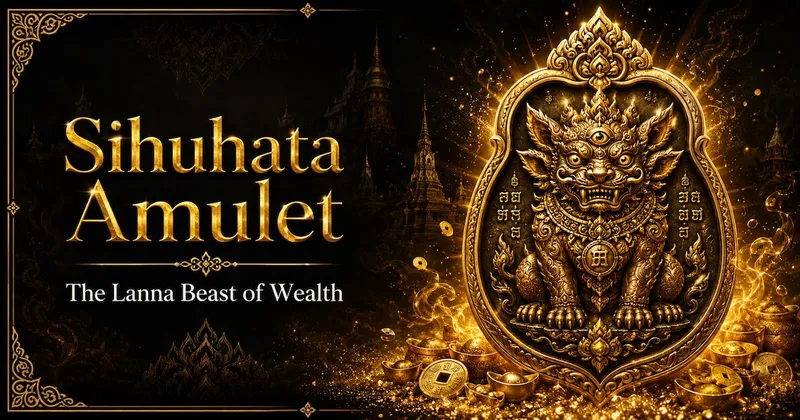
Sihuhata (Thai: สี่หูห้าตา — literally "four ears, five eyes") is the strangest and most charming wealth figure in the Thai devotional world: a fat, black, bear-like beast of Lanna legend that eats red-hot coals and excretes gold. Where other fortune amulets promise to attract money, the Sihuhata promises something subtler — to transform hardship into wealth. Its amulets, rooted in Chiang Rai, have been rising steadily in popularity across Northern Thailand and among overseas Chinese collectors.
The legends
Indra's test. In one popular telling, the god Indra descends in disguise as the Sihuhata and tramples a poor farmer's crops. Instead of striking the beast, the farmer gently ties it, feeds it, and lights a fire to keep it warm. The creature then swallows the glowing coals and excretes gold — rewarding compassion where anger was expected.
The orphan's fortune. In the Chiang Rai version, a virtuous orphan who kept his late parents' moral instructions frees a Sihuhata caught in a snare. The grateful beast eats burning coals, produces gold, and the orphan ends up wealthy enough to marry the king's daughter. Both stories carry the same message: the beast rewards virtue, not offerings.
The Buddhist symbolism
- Four ears — the Four Divine Abodes: loving-kindness, compassion, sympathetic joy, and equanimity. Four ears to listen to the world with an open heart.
- Five eyes — the Five Precepts: no killing, stealing, sexual misconduct, lying, or intoxication. Five eyes to watch one's own conduct.
- Coal into gold: adversity transformed into prosperity — Northern Thailand's most vivid emblem of turning bad luck around.
Powers of the Sihuhata amulet
- Wealth transformation: the signature power — turning honest toil and even setbacks into tangible gains; petitioned for both steady income and windfalls.
- Reversal of misfortune: because the beast literally consumes what burns, it doubles as a remover of bad luck during losing streaks.
- Guarding what you earn: gold comes from the beast and stays under its watch — devotees credit it with plugging money leaks.
- A wearable reminder of virtue: uniquely among fortune amulets, its very anatomy encodes the precepts. Folk belief is blunt about this: break the precepts openly and the blessing quits.
The pilgrimage temple: Wat Phra That Doi Khao Kwai, Chiang Rai
The cult's home is Wat Phra That Doi Khao Kwai (Kaew), a hilltop temple on the southern edge of Chiang Rai city — by legend, the mountain where the beast appeared. A large Sihuhata statue presides over the grounds, and the temple's consecration ceremonies are the source of the most authoritative amulet editions. It is an easy fifteen-minute drive from downtown Chiang Rai and pairs naturally with the White Temple and Blue Temple on a one-day circuit.
Wearing etiquette and taboos
- The Sihuhata is a sacred-animal amulet, not a Buddha image: wear it below any Buddha amulet (see how to wear a Thai amulet).
- Standard etiquette applies — above the waist, removed in unclean places.
- Its blessing is conditional on conduct more explicitly than most amulets: the legends reward precept-keepers, and devotees take that seriously.
- Home statues need only simple offerings — clean water and fruit.
Choosing a genuine piece
Look for editions from Wat Phra That Doi Khao Kwai or other documented Lanna temples, with a named consecration ceremony and year. Souvenir-shop beast pendants without temple provenance are decorations, not consecrated amulets. For neighboring traditions, compare the Nine-Tailed Fox (charm and attraction) and the Wealth Turtle of Luang Phor Liew (steady accumulation) — three animals, three distinct strategies. A broader map of categories is in Thai amulet types explained.
FAQ
Q: Is the Sihuhata the Thai version of the Chinese Pixiu?
A: Close cousins, different logic. The Pixiu swallows wealth and never releases it; the Sihuhata transforms — coal in, gold out — and carries an explicit Buddhist code of conduct.
Q: Sihuhata or Nine-Tailed Fox?
A: The fox governs charm and attraction; the beast governs wealth transformation and luck reversal. They serve different goals and can be worn together.
Q: Can women wear the Sihuhata?
A: Yes. Sacred-animal amulets carry no gender restriction; normal etiquette applies.
Q: Do I need to visit Chiang Rai for it to work?
A: No — the blessing comes from the consecration, not the point of sale. Verify the temple and edition. Visiting the hilltop temple is a bonus, not a requirement.
Last updated: July 2026 | By the Merit Messenger team, based in Bangkok
Interested in Lanna sacred-animal amulets with documented provenance? Browse our collection or contact us.