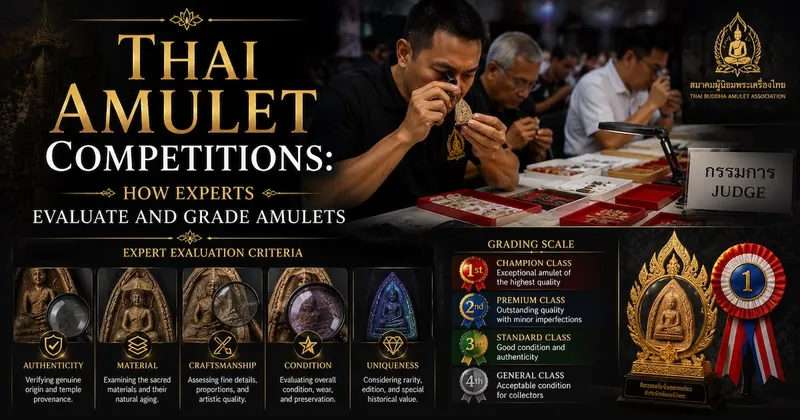
What Are Thai Amulet Competitions?
Thai amulet competitions — known as Samakom Phra or Ngan Phra — are organized events where amulet experts examine, authenticate, and grade amulets submitted by owners and dealers. These competitions serve as the Thai amulet market's primary authentication system, providing the closest thing to an objective quality assessment for objects whose value is ultimately spiritual.
A competition certificate from a recognized Samakom is the gold standard of amulet authentication. For high-value pieces, it is the difference between a credible investment and an expensive gamble. For our detailed guide on what certificates mean for buyers, see our Samakom certificate guide.
How Competitions Work
The typical competition process follows a structured format:
- Submission — Owners bring their amulets to the competition venue and register them in specific categories (by monk, by type, by era, etc.). Each amulet is assigned an identification number.
- Expert examination — A panel of experienced judges examines each piece using magnification tools, reference materials, and decades of accumulated expertise. The examination typically covers material composition, mold characteristics, aging patterns, weight, and overall consistency with known genuine examples.
- Grading — Judges assign grades based on the amulet's authenticity, condition, and quality within its category. The specific grading systems vary between competitions but generally recognize multiple tiers of excellence.
- Certification — Winning pieces receive certificates documenting the competition name, date, category, and grade. These certificates are attached to the amulet's provenance record and significantly affect its market value.
What Judges Look For
Authentication at a Thai amulet competition is primarily visual and tactile, relying on the judges' expertise rather than laboratory testing:
- Mold consistency — Every legitimate edition has documented mold characteristics. Judges compare the submitted piece against reference specimens and photographic databases of known genuine examples.
- Material analysis — Sacred powder amulets have specific grain patterns, density, and surface characteristics that vary by monk and era. Metal amulets have known alloy compositions and casting marks. Experienced judges can detect inconsistencies by sight and touch.
- Aging verification — Genuine vintage amulets develop specific aging patterns: surface patina, hairline cracks, mineral deposits, and color changes that are difficult to replicate convincingly. Judges are trained to distinguish natural aging from artificial aging techniques used by forgers.
- Overall impression — Beyond specific technical criteria, experienced judges develop an intuitive sense for genuine pieces — what Thai collectors call "seeing the face" (hen na) of the amulet. This holistic assessment integrates all the technical factors into a gestalt judgment.
Major Competition Organizations
Thailand has dozens of amulet competition organizations operating at local, regional, and national levels. The most respected include:
- National-level Samakom — Large competitions held in Bangkok and major cities, attracting submissions from across the country. These carry the most market weight.
- Regional specialists — Some competitions specialize in amulets from specific regions or monks, offering deeper expertise in their focus area.
- Temple-affiliated competitions — Organized by major temples to authenticate amulets associated with their own monks and editions.
Not all competitions carry equal authority. Certificates from well-established, reputable organizations are significantly more valuable than those from newer or less rigorous competitions.
How Competition Results Affect Value
Competition certification creates a multi-tier valuation system:
- First prize — A first-prize win at a major competition can multiply an amulet's value several times over. The combination of verified authenticity and recognized excellence creates strong market demand.
- Placement (2nd, 3rd, etc.) — Lower placements still verify authenticity and confirm quality, adding meaningful value.
- Participation certificate — Even submitting to a competition and receiving a participation certificate (without winning) provides a baseline authentication that the piece was examined and not rejected as fake.
- No certificate — Uncertified pieces must rely on other authentication methods (dealer reputation, provenance documentation, expert opinion). This does not mean they are fake — many genuine pieces have never been submitted to competition.
Limitations of the Competition System
While competitions are the best authentication system available, they are not perfect:
- Subjectivity — Authentication relies on human judgment, and honest experts can disagree about borderline cases.
- Fake certificates — Counterfeit competition certificates exist. Verify certificates against the issuing organization's records when possible.
- Not all genuine pieces are certified — Many authentic amulets, especially affordable modern editions, are never submitted to competition. The absence of a certificate does not equal inauthenticity.
Should You Seek Certified Amulets?
For purchases above $300-500, competition certification significantly reduces your authentication risk and is worth seeking. For affordable modern pieces from established temples, the sourcing chain itself provides sufficient confidence without competition certification.
Browse our collection for amulets with verified provenance, or read our buying guide for comprehensive authentication advice.