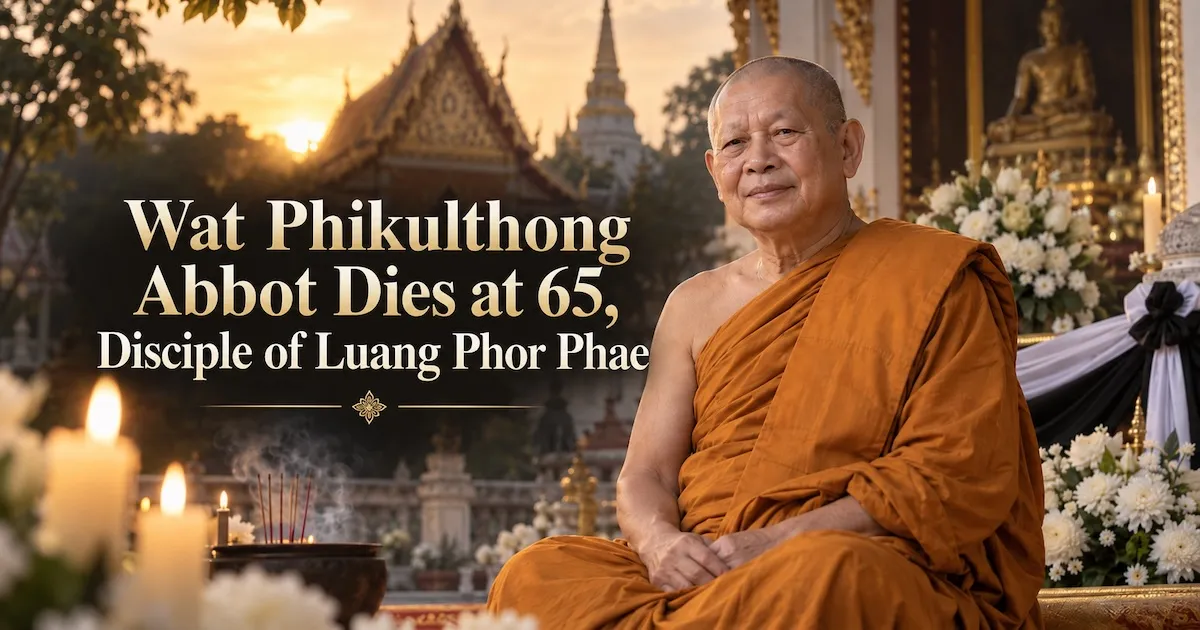
Phra Racha Suwatthanaphon (Dhamma name Sutheero, born Prajuab Khammi), abbot of Wat Phikulthong in Sing Buri province, Thailand, died at 2:50 p.m. on September 15, 2026, at Sing Buri Hospital. He was 65. Hospital officials said he had suffered from an acute cerebral vascular blockage for nine years before his death. Wat Phikulthong is one of Thailand's most significant temples for amulet collectors, as the home temple of the late master monk Luang Phor Phae Khemankaro, whose amulets remain highly regarded among collectors in Thailand and abroad.
Six Decades Tied to Luang Phor Phae's Legacy
Born on July 28, 1961, in Suphan Buri province, Prajuab Khammi ordained as a novice at Wat Phikulthong on April 15, 1975. His preceptor was none other than Luang Phor Phae himself, then holding the ecclesiastical title Phra Khru Sri Phrom Sophit, years before he would become widely known by the honorific "Luang Phor Phae." Suwatthanaphon went on to earn a fourth-grade Pali studies certificate (Prayok 4), rose to become deputy sangha chief of Sing Buri province, and eventually took over as abbot of Wat Phikulthong, a royal temple (Phra Aram Luang), continuing the institution's religious and administrative life for more than two decades after Luang Phor Phae's passing.
Luang Phor Phae: One of the Most Prolific Amulet-Making Monks in Thai History
Luang Phor Phae Khemankaro died on February 10, 1999, at age 94, after 73 years as a monk, and remains one of the 20th century's most revered Thai monastics. He began producing amulets and sacred objects in 1939 and, over his lifetime, created more than 300 distinct amulet molds spanning Somdej-style tablets, pendants, and Buddha images. Unlike monks known chiefly for fine craftsmanship, Luang Phor Phae was famous for prioritizing spiritual potency over aesthetic polish — a reputation that still shapes how collectors evaluate Wat Phikulthong-lineage amulets today. The temple remains one of central Thailand's most important pilgrimage and amulet-collecting destinations, with Luang Phor Phae's amulets a regular fixture of Bangkok's amulet markets and trade fairs, and often a starting point for overseas collectors exploring classic Thai monk lineages.
What This Means for Amulet Collectors
Suwatthanaphon's death marks a leadership transition at a temple that has carried Luang Phor Phae's legacy for over two decades. Following Thai Buddhist custom, temples often commission commemorative amulets during a deceased abbot's funeral rites, so collectors should watch for any memorial editions tied to Wat Phikulthong's coming ceremonies. Because Luang Phor Phae's output spans decades and hundreds of molds, the market for his amulets is also thick with reproductions and misattributions — buyers should always verify certificates and provenance before purchasing; see our guide to Samakom Phra certificates. Readers wanting broader context on Thailand's revered monk lineages can also read our guide to the Nine Great Monks of Thailand, and those considering long-term collecting can consult our guide to Thai amulets as investments.
Source: Dailynews