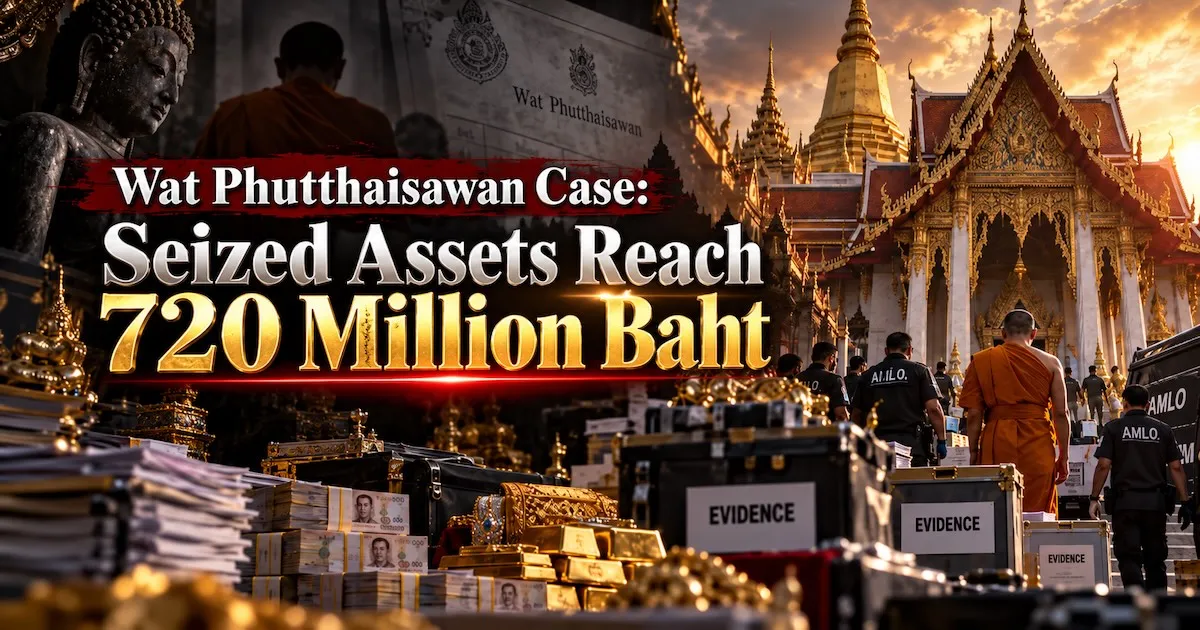
On September 24, 2026, Phithakdet Detchdetcho, a Democrat MP for Nakhon Si Thammarat who chairs the House of Representatives' Committee on Anti-Money Laundering and Narcotics Suppression, briefed reporters after a joint meeting with seven agencies, including the Anti-Money Laundering Office (AMLO), the Bank of Thailand, the Revenue Department, the Interior Ministry, the National Office of Buddhism and the police. Assets seized from six locations in the case against the former abbot of Wat Phutthaisawan in Ayutthaya, known before disrobing as Phra Atichot, and his close associate "Sika A" now total about 720 million baht. Roughly 498 million baht is attributed to the former abbot, with the balance held by associates and related persons. Gold and sacred objects, including amulets, account for more than 200 million baht; the rest is cash, land, vehicles and bank deposits. The figure dwarfs the 300 million baht in seized assets we reported on September 16.
How a Foundation Became the Diversion Channel
According to police findings cited by The Standard, the core method was an account swap. Around 89 million baht in donations for temple maintenance and about 2.8 million baht in amulet rental fees, roughly 92 million baht in total, should have been deposited into the temple's accounts. Instead they were routed into the Wan Chote Foundation (มูลนิธิหวันโชติ), which the former abbot set up in late 2025 with registered capital of just 500,000 baht, and from there into the personal accounts of the former abbot and Sika A. The foundation also issued tax-deductible merit receipts (anumodana receipts) in the temple's name, which it had no authority to do. The committee flagged a further contradiction: the foundation collected the money and distributed the sacred objects, yet the amulet distribution certificates were issued under the temple's name, so the entity taking payment and the entity vouching for the items did not match.
Revenue Department: Not a Single Tax Return
Relaying the Revenue Department's findings, Phithakdet said the former abbot, Sika A, the related persons and the foundation "have no record of ever filing taxes." The committee asked the department to accelerate a retroactive audit extending to Sika A's heirs. Revenue Department Director-General Somsakdi Anantawatana had said on September 22 that a foundation without public-charity status must pay tax on non-donation income, with donations exempt only under specific conditions. The committee also proposed legal amendments to close loopholes that allow religious donations to be used for money laundering, along with tighter oversight of non-profit foundations. Separately, since January 1, 2026, donors who want a tax deduction must give through the official e-Donation system, which about 43,000 Thai temples have joined.
What This Means for Collectors
First, the police summary explicitly lists amulet rental fees as one of the diverted revenue streams. Those fees belong to the temple; once they flow into a private account, the temple's endorsement of that batch of sacred objects is compromised. When renting amulets from a temple, check whether the receipt is issued by the temple itself or by a foundation, because the two carry very different legal weight. Second, the former abbot is the creator of the "Nuea Duang" (Beyond Destiny) commemorative coin, a series that has already seen a price collapse and a refund controversy; this round of disclosures will only weigh further on secondary-market confidence in those pieces. Third, if a court eventually orders the seized amulets and gold forfeited, they could enter a public disposal process under Thailand's anti-money-laundering law, but no auction has been scheduled and any claim that "seized items" are already circulating should be treated as suspect. The case remains under investigation and no court has ruled. For background, see our reports on the abbot's arrest and disrobing, the testimony of dealer Pong Suphan, and our profile of Phra Ajarn Chote and his Jatukam amulets.
Sources: Thairath, Thai PBS, The Standard