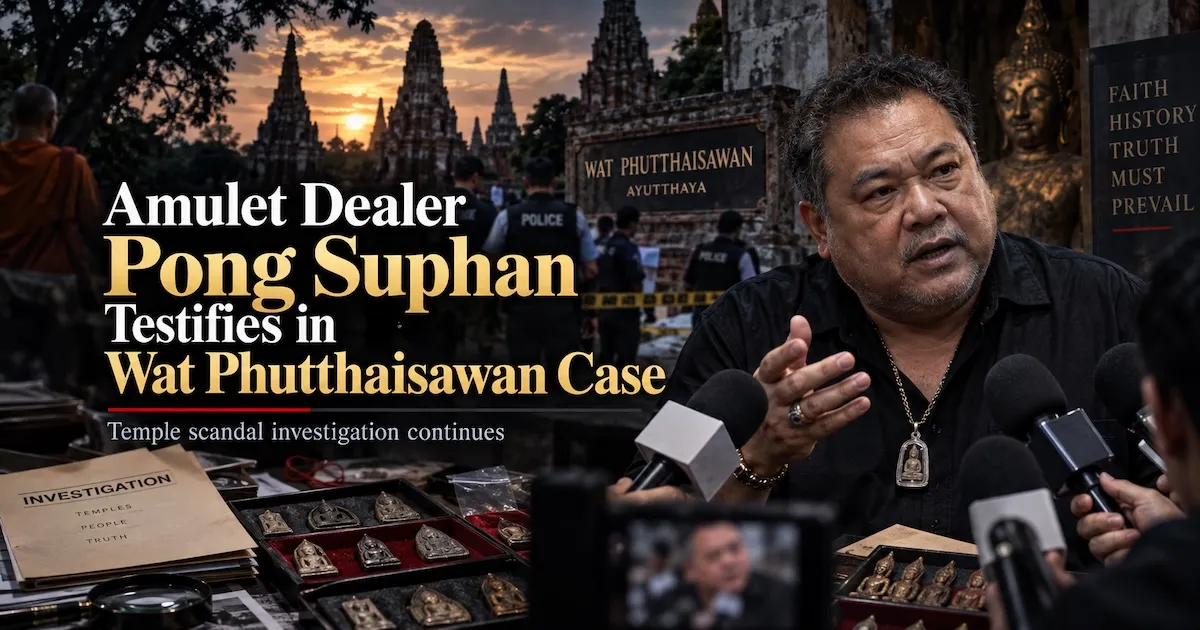
On September 22, 2026, veteran Thai amulet dealer Pong Suphan (ป๋อง สุพรรณ, legal name Samoe Ngiu-ngam) reported to the Central Investigation Bureau (กองปราบปราม) in Bangkok to give testimony over his role as a board member of the Wan Choti Foundation (มูลนิธิหวันโชติ), set up by Phra Ajarn Chote (อติโชติ ทังประเสริฐ), the disrobed former abbot of Wat Phutthaisawan in Ayutthaya province. He was the last of the foundation's six board members to be summoned since the 92-million-baht temple embezzlement scandal broke. The case remains under police investigation; no court has issued a verdict against anyone involved.
Last of Six Board Members to Appear
Thai media report that the Wan Choti Foundation's board has six members, with Phra Ajarn Chote himself serving as chairman before his arrest. Investigators had already questioned the other five board members, all of whom reportedly cooperated and provided information useful to the case. Police, working with Thailand's Anti-Money Laundering Office, also traced each board member's financial transactions. Preliminary checks found no unusual transfers into Pong Suphan's own accounts. Investigators say the central question now is whether the foundation genuinely operated as a charity or served as a channel to move temple donations and merit money into private hands.
The Nuea Duang Coin Connection
Pong Suphan is well known in Thailand's amulet-appraisal circles, and his relationship with Phra Ajarn Chote dates back to when the two collaborated on creating the "Nuea Duang" (เหนือดวง, "Above Fate") gold coin, one of Wat Phutthaisawan's flagship amulet releases. After the abbot's arrest and the temple scandal broke, the coin's market value crashed by nearly 90 percent (see Nuea Duang Coin Crashes 90% After Abbot's Arrest), prompting several dealers to begin refunding buyers. In his statement to police, Pong Suphan insisted he was "merely a board member with no authority to disburse funds" and had never handled the foundation's money, saying he was shocked by the allegations against his former collaborator. His daughter also spoke publicly afterward, stressing that her father is not a criminal suspect.
Where the 92 Million Baht Went
Police say the embezzled funds came from two sources: roughly 2.8 million baht in amulet and sacred-object rental income, and about 89 million baht in temple donations, together exceeding 92 million baht. None of the money reached the temple's own bank account; instead it was routed into the Wan Choti Foundation, which Phra Ajarn Chote had registered only in late 2025, and from there into personal accounts held by the abbot and a close associate. Investigators also found the foundation had issued donation receipts in the temple's name for tax-deduction purposes, despite having no legal authority to do so. The case has already produced a string of asset seizures exceeding 300 million baht, including a cache of gold and cash (see Wat Phutthaisawan Scandal: Amulet Dealer Pong Suphan Summoned), and this round of board-member interviews is the latest chapter.
What This Means for Collectors
For holders and prospective buyers of Wat Phutthaisawan amulets, particularly Nuea Duang coins, the update cuts both ways. On one hand, the preliminary financial trace found no evidence implicating Pong Suphan personally, suggesting investigators are narrowing rather than expanding the scope of blame. On the other, whether the foundation was used to launder donations remains unresolved, meaning market confidence in Phra Ajarn Chote-linked amulets (see our background guide to Phra Ajarn Chote and his Jatukam amulets) will likely stay shaky until the case concludes. The episode is a reminder that even amulets vouched for by famous appraisers deserve independent verification of provenance and consecration records before purchase.
Source: thestandard.co, Daily News