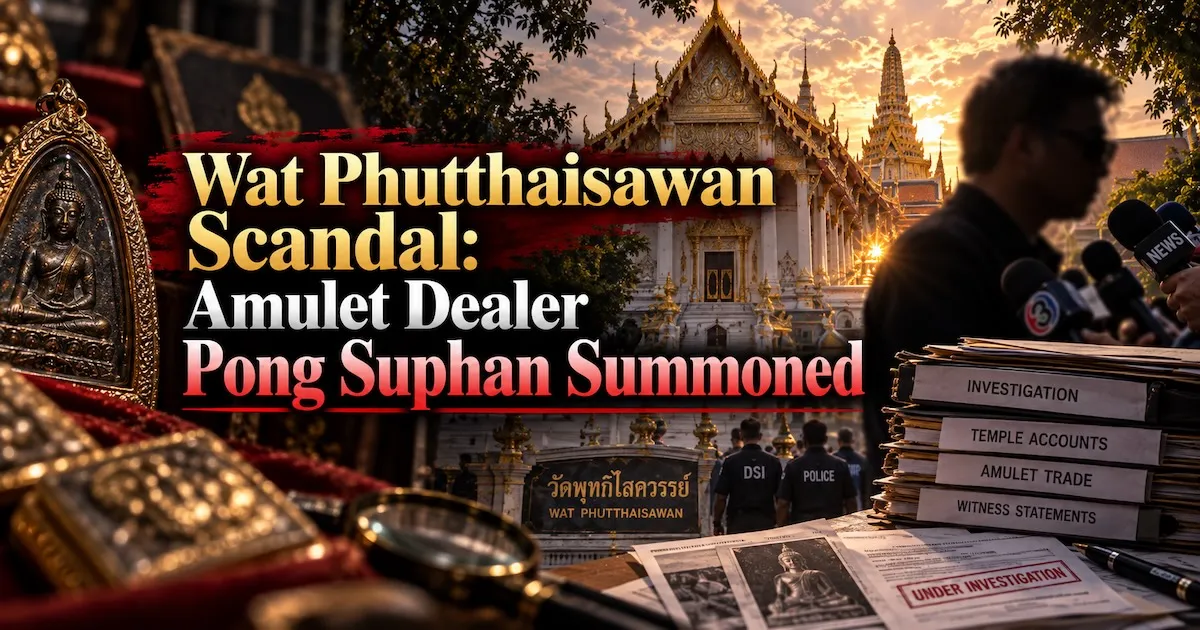
Thailand's Crime Suppression Division (CSD) confirmed on September 20 that it has summoned Pong Suphan (real name Samoe Ngiu-ngam), a veteran figure in the Thai amulet trade, to report on September 22, 2026, over his role as a board member of the Wan Choti Foundation (มูลนิธิหวันโชติ). The foundation was founded and chaired by Atichot, the forcibly disrobed former abbot of Wat Phutthaisawan in Ayutthaya, known during his monkhood as Phra Ajarn Chote.
The Wat Phutthaisawan Scandal Keeps Growing
The case began with a complaint filed in mid-July 2026. On September 10, authorities completed Chote's forced disrobing, and coordinated raids across six locations the next day turned up cash and gold reported at 215.2 million baht — far above the initially reported 92-million-baht embezzlement figure. The investigation has since snowballed past 300 million baht in total assets under scrutiny, with police now moving to unfreeze certain bank accounts while separately tracing Chote's personal finances after leaving the monkhood. Chote is the creator of the Zedujin amulet series, and its flagship Nuea Duang gold coin crashed roughly 90 percent in resale value after the scandal broke, prompting several dealers to offer full refunds.
What the Foundation Investigation Involves
According to Thai media reports, the Wan Choti Foundation has six board members in total, and Pong Suphan is the only one publicly named and summoned so far. He is a well-known "เซียนพระ" — an amulet appraiser and dealer with decades of standing in the trade — who worked closely with Chote over the years to help commission temple coins and merit-making amulets for Wat Phutthaisawan's kathin ceremonies and restoration campaigns. In a July 2024 interview, Pong publicly defended Chote, saying the abbot "never touched temple money" and earned his own income separately through commissioned sacred objects. That statement is now being revisited in light of the scandal. Investigators say they are examining what the foundation was actually used for, and whether it may have served as a vehicle to launder funds.
What This Means for Collectors
As of publication, an initial review of financial records reportedly found no unusual link between Pong Suphan's own accounts and the funds under investigation. He has not been named a criminal suspect, and the summons is described by police as a request for cooperation in his capacity as a foundation board member. The case remains at the investigation stage: no charges have been filed against him, and no court has ruled on anyone's guilt in the broader case. Still, the development is a useful reminder for overseas collectors that a coin or amulet's credibility should never rest on a single respected name alone. When a piece is tied to temple fundraising or a monk-affiliated foundation, it is worth understanding how transparent that organization's finances actually are — a habit that matters far more in the long run than chasing an appraiser's personal endorsement. Readers newer to the hobby can start with our guide to buying Thai amulets safely to build that habit before making a purchase.
Source: Thairath