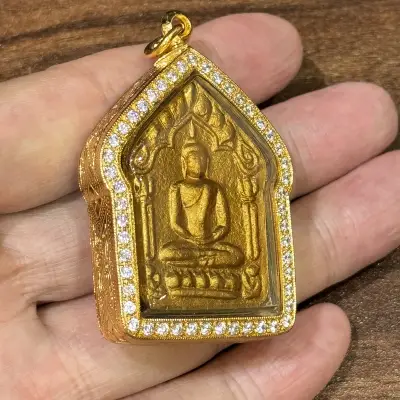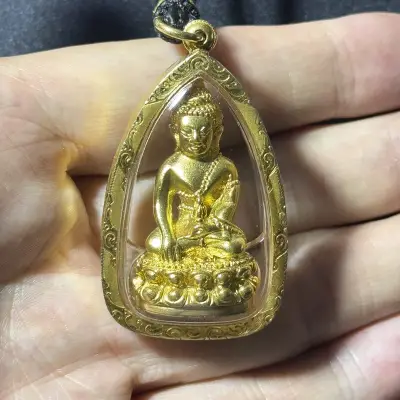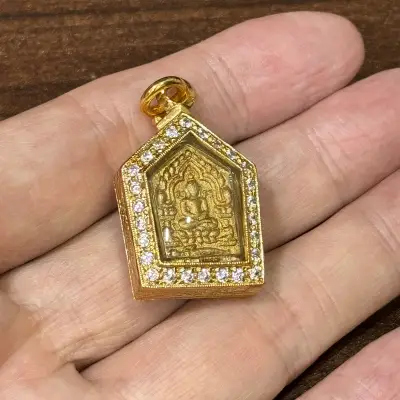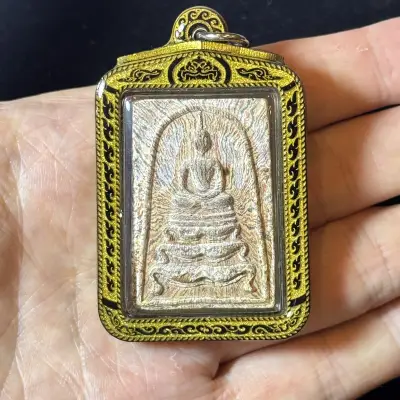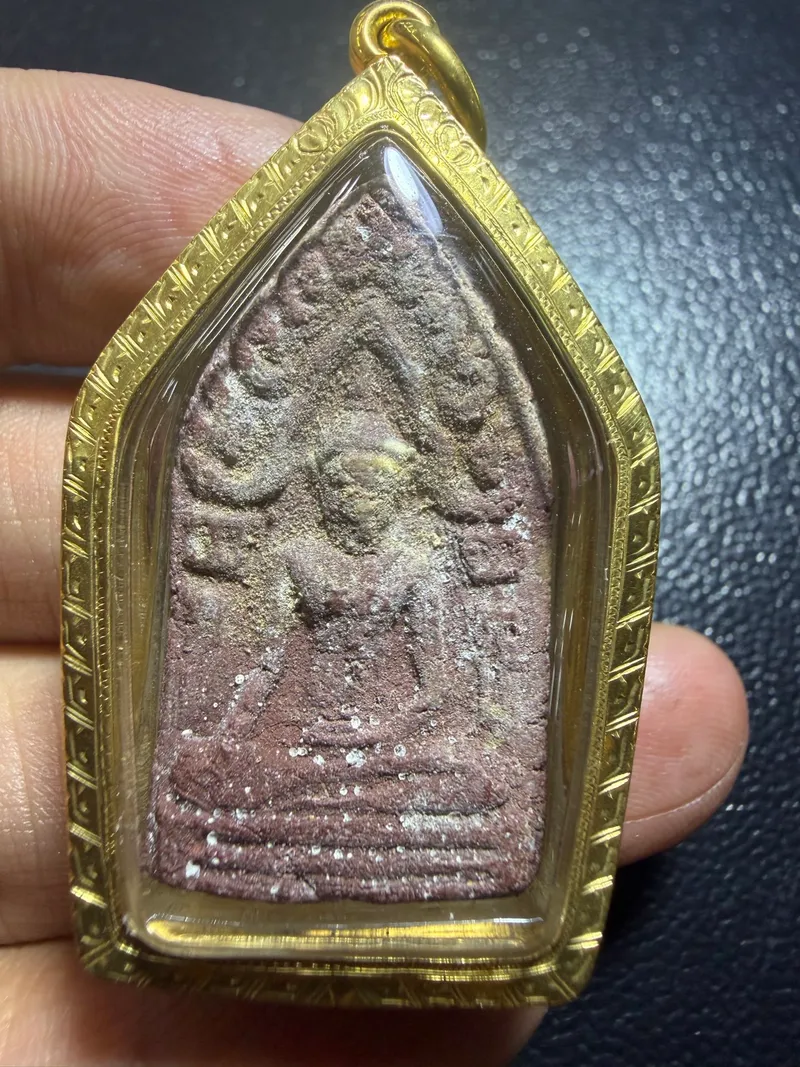
Ajarn Chum Chaikhiri Khun Paen Ruean Kaew (พระขุนแผนเรือนแก้วอาจารย์ชุม ไชยคีรี รุ่นพิธีเสด็จกลับ เนื้อผงผสมว่าน), herbal powder, B.E. 2511 (1968), registered to Wat Tham Khao Ngoen (วัดถ้ำเขาเงิน), Chumphon. Certificate GJ08-A71C9. One piece only. It is held by a partner supplier, so please tap Hold this piece for me and we confirm availability by email within 24 hours.
What is Khun Paen Ruean Kaew?
Khun Paen (ขุนแผน) is a commander in classical Thai literature: handsome, a fine soldier and never short of admirers. Amulets named after him are usually five-sided, and the figure on the front is in fact a Buddha seated in an arch. Devotees wear them for charm, attraction, fortune and winning through. Ruean kaew (เรือนแก้ว) means "jewelled arch", the ornate tiered arch behind the Buddha.
The Association registers this piece as พระขุนแผนเรือนแก้วอาจารย์ชุม ไชยคีรี รุ่นพิธีเสด็จกลับ เนื้อผงผสมว่าน พ.ศ. 2511: Khun Paen Ruean Kaew, Ajarn Chum Chaikhiri, Phithi Sadet Klap batch, powder mixed with sacred herbs, B.E. 2511, from Wat Tham Khao Ngoen in Chumphon. In the batch name, phithi (พิธี) means ceremony and sadet klap (เสด็จกลับ) literally means "the return". Wan (ว่าน) covers the medicinal and sacred roots and herbs that are ground and mixed into amulet powder. The supplier calls the piece the "2511 twin sword Khun Paen, red version": the year agrees with the registration; "twin sword" is the supplier's trade name, no sword is visible on the tablet in the photos, and this page follows the registered name; "red version" describes the red-brown colour, and the registered material is herbal powder, not clay. The supplier also states that Ajarn Chum led the making together with Luang Pho Kong and other masters, that 108 kinds of pollen and sacred ash went into the mix, that it was consecrated at two ceremonies on 12 March B.E. 2510 and 8 February B.E. 2511, that it was issued to raise repair funds for a temple in southern Thailand, and that a film star wears one from the same series. None of that is in the registration and it remains the supplier's account.
Key facts
- Type: Khun Paen (พระขุนแผนเรือนแก้ว), five-sided tablet
- Master: Ajarn Chum Chaikhiri (อาจารย์ชุม ไชยคีรี)
- Batch: Phithi Sadet Klap (รุ่นพิธีเสด็จกลับ)
- Material: powder mixed with sacred herbs (เนื้อผงผสมว่าน), red-brown; the "red version" per the supplier
- Year: B.E. 2511 (1968)
- Temple: Wat Tham Khao Ngoen (วัดถ้ำเขาเงิน), Chumphon
- Ceremonies: two consecrations in B.E. 2510 and 2511, supplier-stated; not in the registration
- Case: five-sided engraved gold-tone case, material not stated
- Certification: Thai Buddha Image Admiration Association, GJ08-A71C9 (box 00795), verifiable on the Association website; the photo shows the yellow slip (authentication receipt) and Association box, and the formal Association card ships with the piece
- Stock: one piece, held by a partner supplier
What people wear it for
- Charm and helpful people
- Fortune and trade
- Winning against competition and breaking through
- Safety and protection from danger
These are devotional beliefs. An amulet does not guarantee any outcome.
Craftsmanship and condition
A five-sided tablet, pointed at the top and square at the base, in a gold-tone case of the same shape. The Buddha sits cross-legged with the right hand lowered to the knee and a pointed finial on the head; the high points of the face and chest are worn smooth and slightly paler. Behind him is an arch built up of several curved tiers with a scrolled border and a short pillar at each foot; beneath the seat is a plinth of stacked horizontal lines. The surface is red-brown, fine and dry in texture, scattered all over with tiny white grains, with a grey-yellow old deposit in the recesses. The back is fairly flat with raised yantra lines: a circle with a centre point in the middle, joined above and below to groups of curves and characters, now somewhat soft, and the lower right area is slightly uneven. The case has a continuous geometric band engraved on the front frame and fine cross-hatching on the back, a clear cover on both sides and a loop at the top.
FAQ
Q: How do I check the certification?
A: Enter GJ08-A71C9 on the Thai Buddha Image Admiration Association website to see the registered name พระขุนแผนเรือนแก้วอาจารย์ชุม ไชยคีรี รุ่นพิธีเสด็จกลับ เนื้อผงผสมว่าน พ.ศ. 2511, registered to วัดถ้ำเขาเงิน (ชุมพร). The last product image shows the Association yellow slip (authentication receipt) with the piece sealed in its box, labelled GJ08-A71C9, box 00795, the slip dated 4 August B.E. 2569. The formal Association card ships with the piece.
Q: Why does the supplier call it the "twin sword Khun Paen"?
A: That is the supplier's trade name. The registered name is ขุนแผนเรือนแก้ว (Khun Paen Ruean Kaew), and no sword is visible on the tablet in the photos. This page follows the registration.
Q: How reliable are the year and the ceremonies?
A: B.E. 2511, Ajarn Chum and the Phithi Sadet Klap batch are stated in the Association registration. The exact ceremony dates, the other masters and the pollen and ash are the supplier's statements.
Q: Is the case gold?
A: The photos show an engraved gold-tone case. The supplier does not state the metal, and the Association does not certify cases.
Q: Who is it for?
A: Traders and sales people, anyone seeking goodwill and helpful people, and collectors of old southern Khun Paen.
Q: Why do I ask you to hold it before paying?
A: This piece is held by a partner supplier rather than in our Bangkok stock. To avoid taking payment for a piece that has already sold, we confirm with the supplier first and reply by email within 24 hours, with a payment link valid for 24 hours if it is available. Asking us to hold it costs nothing.
About this piece
- Includes: one Ajarn Chum Khun Paen Ruean Kaew (in gold-tone case), with Association card GJ08-A71C9
- Price: ฿16,000
- Stock: one piece only
- How to buy: tap Hold this piece for me on this page and pay by the emailed link once availability is confirmed
Last updated: 2026-11-22 | Merit Messenger team, based in Bangkok