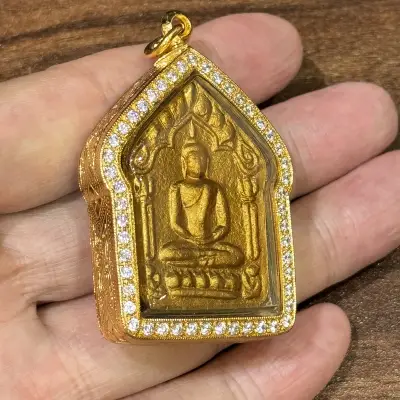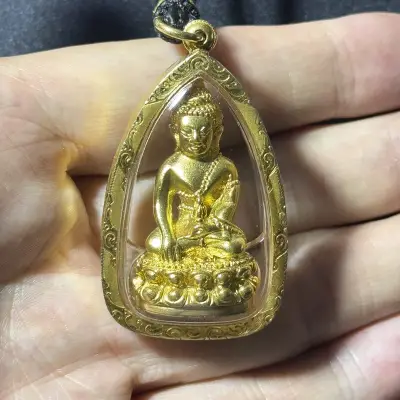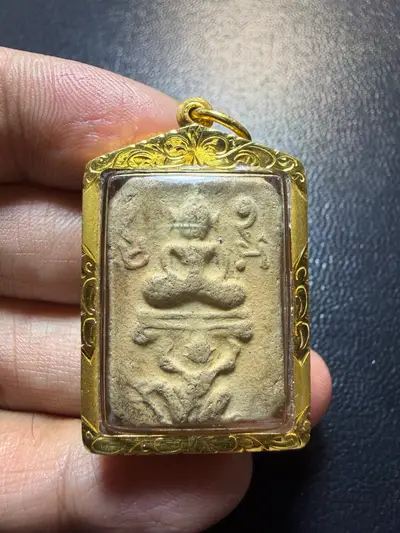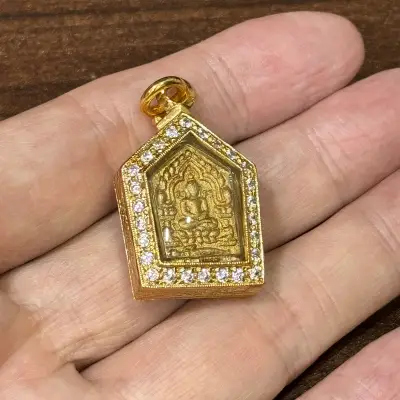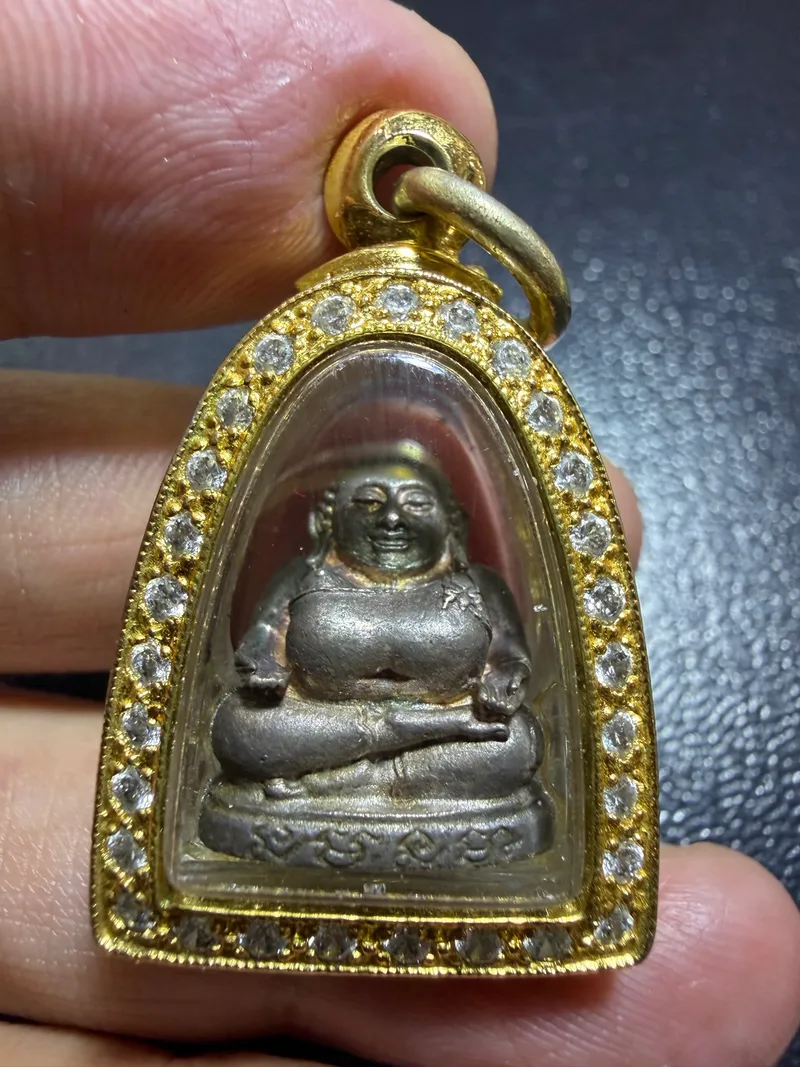
Luang Phor Khun Phra Sangkajai figure, listed by the supplier as the B.E. 2538 (1995) solid-silver edition. Phra Sangkajai was the Buddha's disciple famed for his eloquence and his fortunate, well-fed appearance, and Thais keep his image for a steady flow of income and plenty. One large foot is shown at the front, so Thai collectors call this batch the "big-foot Sangkajai". According to the supplier, it was blessed jointly by Luang Phor Khun and Luang Pu Liew, with many other senior monks invited to the consecration. Judged genuine by the Thai Buddha Image Admiration Association; the authentication receipt names "หลวงพ่อคูณ ปริสุทฺโธ", No. 00468, and the formal certificate is included. Mounted in a gold-tone case set with clear stones, ready to wear. One piece only; it is held by a partner supplier, so please submit a request and we confirm availability by email within 24 hours.
What is the Luang Phor Khun B.E. 2538 Phra Sangkajai (พระสังกัจจายน์ หลวงพ่อคูณ)?
Phra Sangkajai (พระสังกัจจายน์), known in Pali as Kaccayana, was one of the Buddha's great disciples and was renowned for explaining the Dhamma with exceptional eloquence. Thai tradition shows him round-bellied and smiling, a picture of abundant merit, so he is kept above all for steady income and a comfortable life, and is a favourite of people in trade.
Luang Phor Khun Parisuttho (หลวงพ่อคูณ ปริสุทฺโธ) of Wat Ban Rai, Nakhon Ratchasima, is called the "living god of wealth" by Thais. According to the supplier, this Sangkajai was issued in B.E. 2538, blessed jointly by Luang Phor Khun and Luang Pu Liew (หลวงปู่หลิว ปณฺณโก), with the ceremony hosted at Wat Saithongphatana. Its most noticeable feature is the large foot shown at the front, which is why collectors call it the "big-foot" or "turtle-foot" Sangkajai.
Key facts
- Type: Phra Sangkajai figure (พระสังกัจจายน์), known as the "big-foot Sangkajai"
- Material: silver (listed by the supplier as the solid-silver edition)
- Master: Luang Phor Khun Parisuttho (หลวงพ่อคูณ ปริสุทฺโธ), as named on the authentication receipt
- Joint blessing: Luang Pu Liew (according to the supplier)
- Host temple: Wat Saithongphatana (according to the supplier)
- Year: B.E. 2538 (1995) (as stated by the supplier)
- Edition size: according to the supplier, 18,754 pieces in total: 88 gold, 700 silver and 17,966 nawa (nine-metal alloy)
- Certification: judged genuine (แท้) by the Thai Buddha Image Admiration Association, No. 00468, barcode GJ09-10C6E, dated 8 September B.E. 2569 (2026); the formal certificate is included
- Case: gold-tone case set with clear stones, with a ring
- Stock: one piece only, held by a partner supplier
Who was Luang Phor Khun?
Luang Phor Khun was born in Nakhon Ratchasima in B.E. 2466 (1923) and passed away in B.E. 2558 (2015). He spent his monastic life at Wat Ban Rai and became famous for blessing devotees while squatting, tapping their heads, and giving the offerings he received to hospitals and schools. He has a vast following in Thailand and across Southeast Asia, and his amulets are known for wealth and protection. Luang Pu Liew (B.E. 2448 to 2543) of Nakhon Pathom is best known for his turtle amulets; according to the supplier, his turtle incantation was used on this batch.
Blessings
- Steady income: Phra Sangkajai's hallmark, keeping money coming in and not slipping away
- Business and sales: customers, persuasive speech and closing deals
- Goodwill: support and helpful people wherever you go
- Wellbeing: steadiness of body and mind
Please note: an amulet supports your own efforts and intentions; it does not guarantee any outcome. Keeping the Five Precepts is traditionally encouraged.
Craftsmanship
A cast figure of Phra Sangkajai seated cross-legged, round-bellied and smiling, hands resting at the belly, with one large foot shown at the front and a lotus pattern on the base. The back shows the line of the robe and the curled hair, with lettering on the base. The silver has a natural grey-brown patina, lightly polished on the high points. Mounted in a gold-tone case set with clear stones, with a clear front.
FAQ
Q: What is the yellow card in the photos, and which card do I receive?
A: The yellow card is the Thai Buddha Image Admiration Association's authentication receipt, issued on the spot once a piece is judged genuine; the formal certificate is collected on the Thursday of the following week. This piece's yellow card is No. 00468, naming "หลวงพ่อคูณ ปริสุทฺโธ" (Luang Phor Khun), marked "แท้" (genuine), with the "มีซ่อม" (repaired) box left blank, dated 8 September B.E. 2569 (2026). The buyer receives the association's formal certificate.
Q: Does the certificate state the material and year?
A: The receipt names the master only. The solid-silver edition and the year B.E. 2538 are as stated by the supplier.
Q: Is Phra Sangkajai the same as the Chinese Laughing Buddha?
A: No. Both are shown round-bellied and smiling, but Phra Sangkajai is the Buddha's disciple Kaccayana, revered in Theravada Thailand, while the Laughing Buddha is associated with Maitreya in Chinese Buddhism.
Q: Who is it suited to?
A: People in business and sales, anyone whose work keeps them on the move, those who want to hold on to their savings, and collectors of Luang Phor Khun.
Q: Why do I request first and pay later?
A: This piece is held by a partner supplier rather than in our Bangkok stock. So that nobody pays for a piece that has already gone, we confirm with the supplier first and reply by email within 24 hours. If it is available, the email includes a payment link valid for 24 hours. Submitting a request costs nothing.
About this piece
- Includes: the Sangkajai figure in its gold-tone stone-set case and the Thai Buddha Image Admiration Association formal certificate (No. 00468)
- Price: ฿12,000
- Stock: one piece only
- How to buy: submit a request on this page; pay through the emailed link once availability is confirmed
Last updated: 2026-10-29 | Merit Messenger team (Bangkok-based)