Bangkok: The World Capital of Thai Amulets
Bangkok is home to the world's largest concentration of Thai amulet markets, dealers, and temple sources. The city's amulet trade is a multi-billion-baht industry that operates openly across dedicated markets, temple grounds, and specialist shops. For anyone serious about Thai amulets, visiting Bangkok's markets is an unforgettable experience — part spiritual pilgrimage, part treasure hunt, part cultural immersion.
This guide covers the major amulet markets, what to expect when you visit, practical tips for navigating the culture and commerce, and alternatives if you cannot travel to Thailand in person.
Tha Prachan: The Epicenter
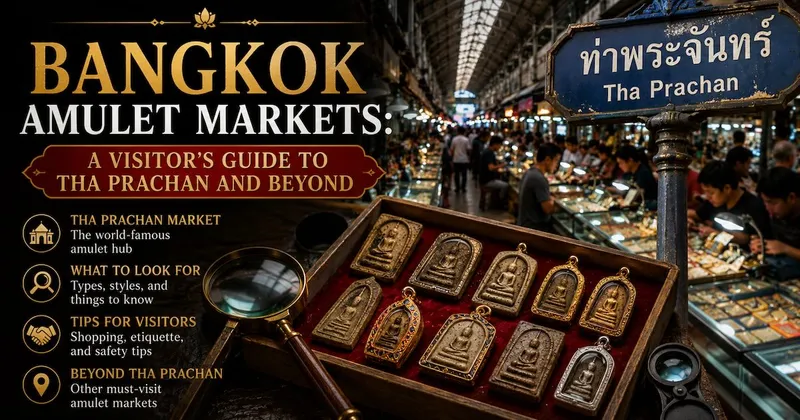
Tha Prachan market, located near the Grand Palace and Thammasat University along the Chao Phraya River, is the most famous amulet market in Thailand. It operates daily but reaches peak activity on weekends, when thousands of dealers and buyers converge.
What to Expect
- Scale — Hundreds of vendors spread across covered stalls, open-air tables, and surrounding shop-houses. The variety is overwhelming for first-time visitors: tables covered with thousands of amulets of every type, age, and price range.
- Expertise — Many vendors at Tha Prachan are lifelong specialists who can identify amulets, monks, editions, and approximate values on sight. The knowledge concentrated in this market is extraordinary.
- Price range — From 100-baht tray amulets to pieces worth millions. The same market serves temple devotees looking for affordable daily-wear amulets and serious collectors hunting rare vintage pieces.
- Atmosphere — Despite the commercial activity, Tha Prachan retains a distinctly respectful atmosphere. These are sacred objects, and both buyers and sellers treat them accordingly.
Navigation Tips
- Start early — The best selection is available in the morning, especially on weekends. Serious dealers arrive at dawn.
- Walk the entire market first — Do a full loop before buying anything. Compare prices, note what catches your eye, and return to purchase after you have seen the full range.
- Bring cash — While some vendors accept digital payment, cash is still the primary medium, especially for negotiating.
- Learn basic Thai numbers — Even a few words of Thai go a long way in building rapport with vendors and getting fair prices.
Other Key Amulet Markets in Bangkok
- Wat Ratchanadda (Loha Prasat) — A significant amulet market located near the Golden Mount. Smaller and more tourist-accessible than Tha Prachan, with a good mix of affordable and mid-range pieces. The covered market building makes it comfortable even in Bangkok's heat.
- Pantip Plaza amulet sections — Several floors of this famous electronics mall have been converted to amulet stalls, creating a climate-controlled alternative to open-air markets.
- Weekend temple markets — Many Bangkok temples hold weekend amulet markets on their grounds, where monks sell recently consecrated pieces directly. These are excellent sources for affordable, guaranteed-authentic amulets.
Visiting Temples Directly
For the most authentic and trustworthy experience, consider visiting the temple source directly:
- Wat Rakang Kositaram — The home of the original Phra Somdej, this temple sells commemorative editions and maintains a museum of Somdej Toh's legacy.
- Wat Bowonniwet — A royal temple with strong connections to Thai monarchy and significant amulet history.
- Wat Suthat — One of Bangkok's most important temples, known for its own line of consecrated amulets.
- Wat Huay Mongkol (Hua Hin) — Home of the world's largest Luang Phor Thuad statue, a popular day trip from Bangkok for LP Thuad devotees.
Temple purchases have one significant advantage: you know exactly where the amulet comes from and that it was properly consecrated, eliminating authenticity concerns.
Bargaining and Etiquette
- Bargaining is expected — Unlike temple purchases (fixed prices), market vendors expect negotiation. Starting at 60-70% of the asking price is reasonable for most items.
- Respect the objects — Even while bargaining, handle amulets carefully and respectfully. Never toss them on the table or treat them as ordinary merchandise.
- Ask questions — Vendors appreciate genuine interest. Ask about the monk, the temple, the year, and the ceremony. This both educates you and signals that you are a knowledgeable buyer who cannot be easily fooled.
- Walk away politely — If the price is not right, thank the vendor and move on. Aggressive bargaining is culturally inappropriate for sacred objects.
Scam Awareness
While the vast majority of Thai amulet dealers are honest, scams do exist, particularly targeting foreign tourists:
- "Ancient" amulets at tourist markets — If someone approaches you at a tourist attraction offering a supposedly ancient, valuable amulet at a fraction of its claimed worth, it is almost certainly fake.
- Tuk-tuk driver recommendations — Drivers who offer to take you to a "special" amulet shop typically receive commissions, and the shops they recommend often overcharge significantly.
- Too-good-to-be-true stories — "My grandmother found this in a temple wall" or "This is from a famous monk who just passed away" — unsolicited sales pitches with dramatic backstories are red flags.
Stick to established markets, reputable shops, and temple sources to minimize risk.
Cannot Visit Thailand? Buy Online with Confidence
Not everyone can travel to Bangkok. For overseas buyers, the key is finding an online dealer with verifiable temple relationships and transparent sourcing. At Merit Messenger, we source directly from Thai temples and provide provenance documentation for every piece.
Browse our online collection for temple-sourced amulets with worldwide shipping, or read our guide to safe online purchasing. For first-time buyers, our choosing guide helps you find the right amulet regardless of where you shop.