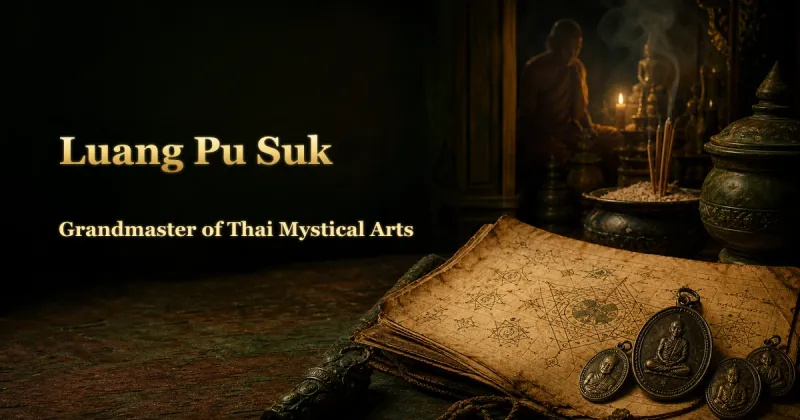
Every tradition keeps one name for the summit. In Thai mystical arts — wicha, the esoteric sciences of yant, incantation, and transformation — that name is Luang Pu Suk Kesaro (1847-1923) of Wat Pak Khlong Makham Thao in Chai Nat province. A century after his death, when Thai collectors rank the masters of pure magical attainment, Luang Pu Suk is not argued about; he is the reference point. And his most famous disciple explains why the legend crossed from folk devotion into national history: Prince Abhakara Kiartivongse of Chumphon — the father of the Royal Thai Navy.
The master of Makham Thao
Born in 1847, Suk ordained in the Mahanikaya order and spent years in tudong wandering before returning in 1892 to his home region, settling at the riverside temple of Wat Pak Khlong Makham Thao on the Chao Phraya in Chai Nat. He rebuilt the decaying monastery and, over three decades, built something larger: a reputation for discipline and command of wicha that drew students from across Siam. He died in 1923 (BE 2466), and his temple remains a pilgrimage site with his shrine at its heart.
The prince and the monk
The relationship that sealed the legend: Prince Chumphon — King Chulalongkorn's son, founder of the modern Thai navy, and himself a serious student of traditional arts — took Luang Pu Suk as his master in the esoteric sciences. The image of Siam's most modern military mind bowing to a provincial monk for instruction told the country everything it needed to know about the old master's attainment. Their portraits hang together in Thai homes and naval offices to this day, and navy devotion to both men remains living tradition.
The transformation folklore
Luang Pu Suk's wicha is remembered through a century of demonstration tales — famously, transforming leaves and cloth into living creatures before astonished visitors, then back again. Told and retold, these stories function the way miracle accounts always do in Thai devotional culture: not as claims to litigate, but as the community's way of ranking attainment. No monk of his era accumulated more such stories, which is precisely why his objects carry the weight they do.
The amulets: Pidta and takrut
- Phra Pidta, BE 2464-2466 (1921-1923): his celebrated closed-eyes Buddha pieces, pressed from powder bound with lacquer (nuea pong kluk rak) in his final years — apex collectibles of the Pidta category. For the type's meaning, see our Phra Pidta guide.
- Hand-inscribed takrut: protective scrolls in the classical manner — see our takrut guide — prized for the master's own yant work.
- Medallions (rian): his BE 2466 portrait medal, struck in his final year, is one of Thai amulet history's most important rians — heavily faked, fiercely certified, and priced accordingly.
Powers attributed across the set: comprehensive protection (the kong grapan portfolio), command and authority, and deliverance from hostile magic — the domains of a wicha grandmaster.
Collecting guidance
A century of fame plus tiny lifetime supply equals one of the market's most counterfeited names. His death in 1923 brackets everything: lifetime pieces are museum-tier with certificates doing half the work, while Wat Pak Khlong Makham Thao's later commemorative editions offer the lineage at realistic prices — honest sellers distinguish the two without being asked. Verify against published references and competition certificates; the fundamentals are in buying Thai amulets online safely.
FAQ
Q: Was Luang Pu Suk a "magic monk" rather than a Buddhist teacher?
A: The distinction is modern. In his era, mastery of wicha and monastic discipline were one vocation; his temple duties, rebuilding work, and teaching were as central as the folklore. Thai tradition remembers him as both.
Q: What is his connection to other great masters?
A: He stands in the same generation as the founders of central Thailand's great lineages, and collector convention counts him among the nine greatest masters — the supreme name in the mystical-arts lane. The wider map is in Thai amulet types explained.
Q: Can ordinary collectors afford anything of his?
A: Lifetime pieces, realistically no. Temple commemorative editions and lineage pieces from Chai Nat keep the connection accessible.
Last updated: July 2026 | By the Merit Messenger team, based in Bangkok
Looking for documented lineage pieces from Thailand's classic masters? Browse our collection or contact us.