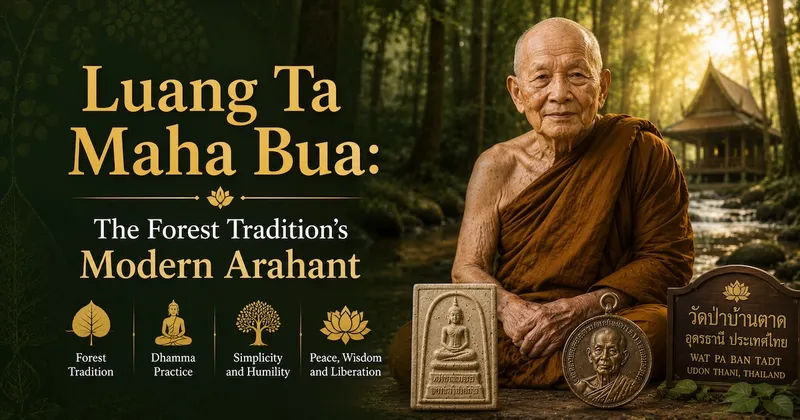
Luang Ta Maha Bua Ñāṇasampanno (1913–2011) was a direct disciple of Ajahn Mun and a grand master of the Thai Forest Tradition. Unlike masters known for magical amulets, he is revered for the purity and dignity of his practice, and his amulets are non-commercial objects of pure cultivation.
Life: a lifetime of forest asceticism
Born Bua Lohitdi with the Dhamma name Ñāṇasampanno on 12 August 1913, he passed away on 30 January 2011. He took up forest meditation early and became a direct disciple of Ajahn Mun Bhuridatta, the founder of the Thai Forest Tradition, mastering his ascetic practice and insight meditation. After Ajahn Thate passed in 1994, he was recognized as the head monk (Ajahn Yai) of the Thai Forest Tradition until his own death in 2011.
Wat Pa Baan Taad and the dhutanga practices
In November 1955, with a donation of land, Luang Ta Maha Bua founded Wat Pa Baan Taad in Udon Thani. The monastery deliberately preserves the forest in its original state, so that monks, novices, and laypeople can use its tranquility to practice the Dhamma. Practice there centers on the dhutanga (the thirteen ascetic practices) — precisely the path taught by Ajahn Mun that he upheld all his life.
"Save Thai Nation" and love of country
After the 1997 Asian financial crisis, Luang Ta Maha Bua launched the famous "Save Thai Nation" campaign, calling on the faithful to donate gold and foreign currency to bolster the national reserves — a concern for the nation beyond personal practice that made him a spiritual leader revered across the country.
Amulets and relics: witnesses to practice
Luang Ta Maha Bua's amulets carry not the promise of worldly magic but the cultivated power and blessing of a pure master. After his cremation, his remains are said to have transformed into crystalline relics (phra that) — in Thai belief a sign of arahantship. His amulets are thus treasured as "witnesses to pure practice," in keeping with the Forest Tradition's ideal of protection through the Dhamma and cultivation of the mind.
FAQ
What do Luang Ta Maha Bua's amulets offer?
Unlike magical amulets, his carry the cultivated power and blessing of a pure master, centered on protection, peace of mind, and inner cultivation rather than promises of worldly wealth — in keeping with the Forest Tradition's "protection through the Dhamma."
How is he related to Ajahn Mun?
He was a direct disciple of Ajahn Mun, mastering his ascetic practice and insight meditation, and later became the head monk of the Thai Forest Tradition.
What are "relics" and why do they matter?
Relics (phra that) are the crystalline remains left after a master's cremation. In Thai belief they are a sign of spiritual attainment, even arahantship, and are deeply venerated by the faithful.
What was "Save Thai Nation"?
After the 1997 financial crisis, Luang Ta Maha Bua launched a campaign urging the faithful to donate gold and foreign currency to strengthen the national reserves — an act of patriotism that made him a revered spiritual leader.
Last updated: July 2026 | Author: The Merit Messenger Team (based in Bangkok)
Want to learn about the Thai Forest Tradition and more masters? Read the Nine Great Monks of Thailand, or contact us. For terminology, see the Thai amulet glossary.