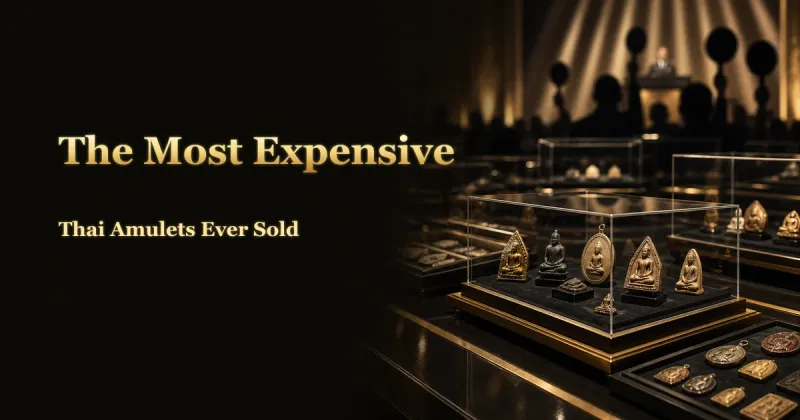
The most expensive Thai amulets are small enough to hide in a closed fist and trade at prices that rival fine art. The late Thai billionaire Vichai Srivaddhanaprabha — owner of Leicester City FC — is widely reported to have paid 100 million baht (over US$3 million) for a single Phra Somdej. A first-batch Phra Somdej Wat Rakhang reportedly changed hands for 20 million baht in 2020. This guide tours the top of the market: which pieces command such prices, and the logic behind them. One caveat throughout: the highest sales happen privately, so record figures are collector lore and press reports, not auction-house ledgers.
What makes an amulet worth millions
- Lineage: created by a legendary master — the single greatest driver. A tablet pressed by Somdej Toh himself carries his sanctity in a way no later edition can.
- Scarcity: original batches were small and attrition over a century is brutal; surviving top-condition pieces number in the dozens, not thousands.
- Documentation: competition certificates, published catalog references, and unbroken ownership history. At this level, paper is half the price.
- Condition and pim: mold variant and preservation grade split otherwise identical pieces by multiples.
The record holders
1. Phra Somdej Wat Rakhang — the 100-million-baht tablet
The undisputed summit. Pressed in the mid-1800s under Somdej Toh at Wat Rakhang, first-batch examples in famous pim variants are the market's ultimate trophy — the reported nine-figure sales all belong here. Full background in our Phra Somdej guide.
2. The rest of the Benjapakee set
The five classic amulets — Somdej, Phra Rod, Nang Phaya, Phong Suphan, Sum Kor — are each valued from roughly ten million baht upward in original excavated form. Assembling a complete authentic set is a lifetime project for Thailand's wealthiest collectors.
3. Phra Kring Pavares — the royal casting
Cast at Wat Bowonniwet in the late nineteenth century in tiny numbers for royalty and senior monks, the founding Thai Kring is functionally priceless: pieces essentially never reach the open market.
4. Luang Phor Thuad, Wat Chang Hai BE 2497
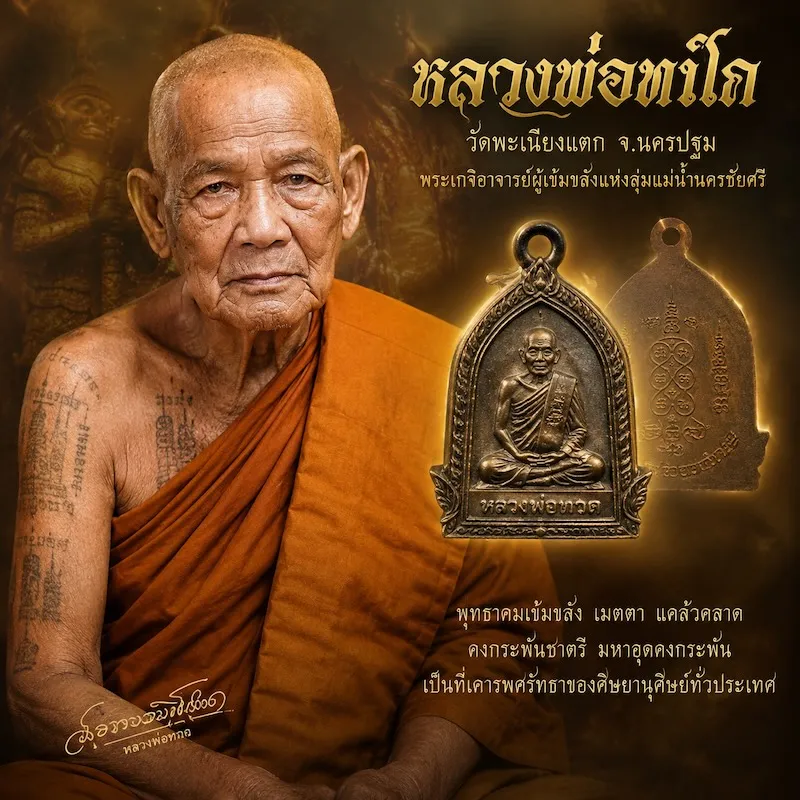
The first-generation editions of Thailand's most beloved protective monk — see our Luang Phor Thuad guide — are the postwar market's blue chips, with top pim examples reported in the tens of millions of baht.
5. Luang Phor Tim's Khun Paen Phong Prai Kuman
The celebrated Khun Paen editions of Luang Phor Tim of Wat Lahanrai (BE 2515-2517) are the modern era's champions — million-baht-and-up pieces barely fifty years old, proof the market keeps minting classics.
Why prices stay high: the economics
Three structural forces hold the summit up. Faith gives the objects meaning money cannot replicate. Scarcity is absolute — Somdej Toh will press no more tablets. And the collector hierarchy is institutionalized: amulet competitions, grading associations, and specialist publications function like the art world's authentication apparatus. Notably, none of this enriches the original temples — the secondary market runs entirely among collectors, a dynamic we unpack in how temples actually fund themselves.
The cautionary tales
Where money concentrates, so do fakes and manias. At the top end, forgery is a craft industry of its own — which is why provenance paper halves the risk and doubles the price. And hype can manufacture a summit that collapses: the Jatukam Ramathep bubble of 2007 saw mass-produced editions briefly trade at fifty thousand baht before falling back to hundreds. The record holders above survived a century of scrutiny; that is exactly what the bubble pieces lacked.
What this means for ordinary collectors
You are not buying a 100-million-baht Somdej — and you do not need to. The same masters' temples issue documented successor editions at accessible prices, carrying the same tradition. Spend on provenance, not on stories: a modest piece with a certificate beats a "rare original" with only a seller's word, every single time. Our guide to buying Thai amulets online covers the checks.
FAQ
Q: Are these record prices verified?
A: Only partially. Top sales are private; figures come from press reports and collector consensus. Treat exact numbers as lore, the price tier as real.
Q: Are expensive amulets spiritually stronger?
A: Thai teaching says no — price reflects rarity and history, not blessing. A properly consecrated modern edition protects its wearer just as fully.
Q: Is amulet collecting a good investment?
A: The blue chips have appreciated for decades, but authentication risk is severe and liquidity is thin. Collect from faith and interest first; treat appreciation as a bonus.
Last updated: July 2026 | By the Merit Messenger team, based in Bangkok
Looking for documented pieces at sane prices? Browse our collection — every amulet lists temple, year, and authentication status — or contact us.