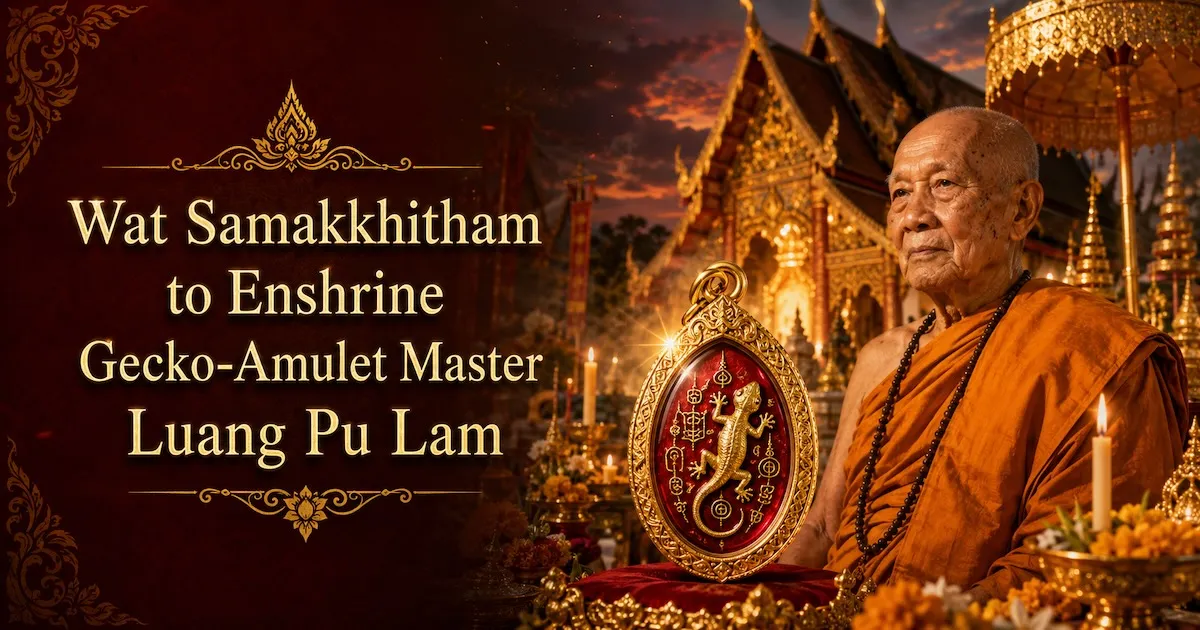
Disciples and lay Buddhists at Wat Samakkhitham (วัดสามัคคีธรรม), in Bangkok's Wang Thonglang district, will hold a major ceremony on August 31, 2026 at 8:00 a.m. to move the preserved body (sarira, สรีระสังขาร) of the temple's founding abbot, Luang Pu Lam Siritammo (หลวงปู่หล่ำ สิริธัมโม), into a newly completed memorial stupa, the Luang Pu Lam Mondop. Construction of the mondop began on March 22, 2024, exactly five years after the monk's death, and has now been finished in time for the enshrinement.
Who Was Luang Pu Lam?
Born into a Thai-Chinese family with an early fascination with the occult, Luang Pu Lam studied Khmer sacred script (Khom script) under Achan Chat Phasuko as a boy before becoming a close disciple of Luang Phor Khruen (หลวงพ่อครื้น) of Wat Sangkho in Suphanburi, one of the most celebrated masters of supernormal powers (abhiñña) in 20th-century Thai amulet history. In 1969, Luang Pu Lam founded Wat Samakkhitham on the belief that "the Dhamma must reach the people," opening the temple to visitors of every nationality, faith, and profession. He passed away on March 22, 2019, at 3:40 a.m.
The Gecko Amulet and Thao Wessuwan Legacy
Among collectors, Luang Pu Lam is best remembered as the monk entrusted to consecrate the temple's Tukkae, or two-tailed gecko (Jing Jok) amulets. According to temple accounts, his teacher Luang Phor Khruen personally handed him the ritual in his later years and praised his work, reportedly saying "Lam does it just like his father [teacher]." That endorsement has since underpinned the reputation of Wat Samakkhitham's gecko amulets as an authentic branch of the Wat Sangkho lineage. Luang Pu Lam also consecrated Thao Wessuwan guardian-giant amulets, Phra Pidta pieces, and "Mae Nang Tukata" spirit-doll charms — affordable, widely circulated pieces that remain fixtures on household altars across Thailand.
Why an Incorrupt Body Matters
In Thai Theravada tradition, a revered monk's body failing to decompose after death is popularly regarded as physical evidence of accumulated merit and meditative attainment. Such bodies are typically displayed in glass caskets for public veneration before eventual enshrinement in a purpose-built mondop or stupa. Luang Pu Lam's sarira has been kept at the temple for more than seven years since his passing. The August 31 ceremony will be led by the current abbot, Phra Khru Pariyat Vachiratham, and assistant abbot Phra Maha Wiboon Kitcasaro, and is expected to draw large numbers of gecko-amulet and Thao Wessuwan collectors paying their respects.
What This Means for Amulet Collectors
Luang Pu Lam's story fills in a lesser-known but distinctive branch of Thailand's monk-lineage amulet tradition: the gecko amulet has more than one authoritative source, and the Wat Sangkho-to-Wat Samakkhitham line sits alongside the more widely documented Thao Wessuwan lineage of Luang Phor Itthi as one of the two major currents behind today's Thao Wessuwan market. For collectors, correctly identifying which monk and temple consecrated a piece remains the first step in judging its historical value and authenticity — and it directly affects resale prices in the secondary market.
Source: Dailynews