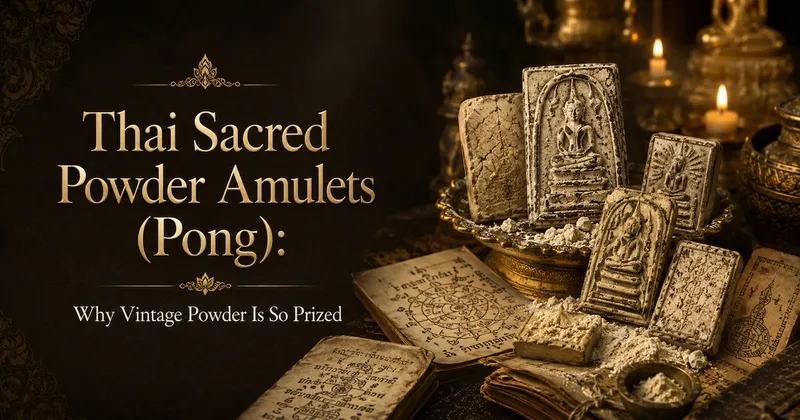
What "Pong" Actually Is
Most Thai amulets are not cast from metal — they are pressed from sacred powder, or pong (ผง). To the newcomer a powder amulet can look humble next to a shining coin, but in the eyes of experienced collectors the reverse is often true. Some of the most valuable and spiritually esteemed amulets in Thai history are pressed powder, and vintage powder in particular commands deep respect. This guide explains what sacred powder is, why age matters so much, and how to think about old-powder pieces.
Not Dust — a Composed Sacred Recipe
Sacred powder is a meticulously assembled mixture that can draw on dozens or even hundreds of ingredients. Depending on the temple and master, it may include:
- Ground fragments of revered monks' robes, relics, or personal effects
- Sacred herbs and plants with traditional spiritual associations
- Consecrated ash from ceremonial fires and burnt yantra inscriptions
- Sacred earth gathered from temple grounds and pilgrimage sites
- Powdered chalk from inscribed and erased sacred writing (pong wised and related powders)
- Binding agents such as sacred lacquer, banana sap, or honey, pressed in traditional molds
The recipe and its proportions are usually a closely guarded lineage secret, and a master may spend years — sometimes decades — accumulating the ingredients for a single major batch. This is the sense in which a powder amulet "contains" a master's practice: the pong itself is the accumulated material of his devotion.
The Itthije Maha Phut Tradition
Some powder formulas become legends in their own right. One such is Itthije Maha Phut (อิทธิเจมหาภูติ), the signature sacred powder of Luang Pho Chai of Wat Hua Wao in Singburi — gathered from seven sacred sources and ground and chanted over for years by traditional method. In old-amulet circles this powder is regarded as one of the classic legendary formulas, and pieces made from it are sought after precisely for the pong, not only the image. You can see it in the Luang Pho Chai Phra Phuttha Chinnarat powder amulet, B.E. 2497 ($98), a genuine seventy-year-old piece.
Why Vintage Powder Is So Prized
Three forces converge to make old powder valuable:
- Irreplaceable ingredients. Old formulas used relics and materials that no longer exist and cannot be reproduced. A modern batch cannot include a fragment of a robe that was fully consumed decades ago.
- A closed supply. Once a master has died, no more of his personally consecrated powder can ever be made. Every surviving piece is part of a fixed, shrinking pool.
- Accumulated reverence. Collectors speak of the "resonance" a piece gathers over decades of being prayed with and honored — a quality no freshly pressed amulet can have yet.
The Luang Pho Pae Phra Pidta in dark-grey powder with gold leaf ($168), a final-year issue from a master who passed in 1999, is another example of powder whose value rests on exactly these factors.
Reading and Judging Old Powder
Experienced buyers assess vintage powder by a few observable signs. Genuine age shows as natural, even surface wear and a settled patina; the powder body should feel consistent with its claimed formula and era. Beware of artificial aging — chemically forced patina and deliberately gouged "wear" tend to look overdone, with grime packed unnaturally into recesses. Because judging old powder is a real skill, newcomers should lean heavily on documentation and trusted sourcing rather than on their own eye alone. Our guide to dating Thai amulets helps you make sense of the Buddhist Era years these pieces carry.
How to Care for a Powder Amulet
Powder is more fragile than metal. Keep it dry — the sacred composition can degrade with moisture, so remove it before swimming or bathing and let it air-dry slowly if it ever gets wet. Never use water, chemicals, or ultrasonic cleaners. A protective waterproof case is strongly recommended for daily wear, and many old powder pieces are cased for exactly this reason.
Frequently Asked Questions
Is a powder amulet weaker than a metal one?
No. Material is a matter of character, not rank. Powder amulets are prized for a soft, pervasive energy that integrates with the wearer over time, and many of the most revered amulets in Thai history are pressed powder. Metal and powder simply suit different tastes and purposes.
How can I tell if old powder is genuine?
It takes experience. Look for natural, even wear and a coherent powder body, and be suspicious of overdone "aging." For anything of real value, rely on provenance, documentation, and a trustworthy source rather than on appearance alone.
Why can't a famous old powder just be remade today?
Because the original ingredients — specific relics, robes, and materials, plus the personal consecration of a now-deceased master — cannot be recreated. A tribute batch can honor a formula, but it is not the same powder.
Curious about a specific vintage powder piece? Ask us on WhatsApp.