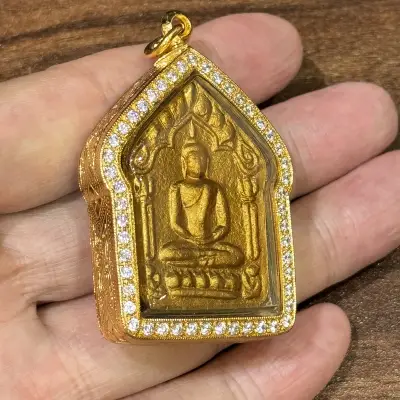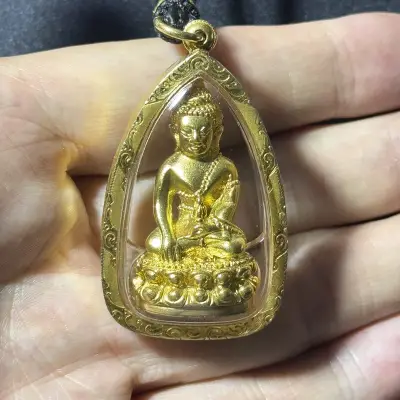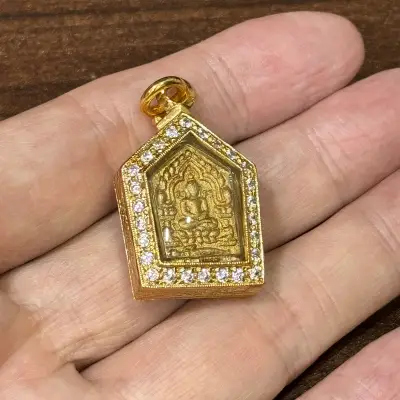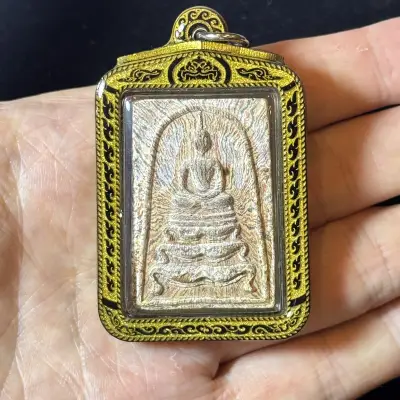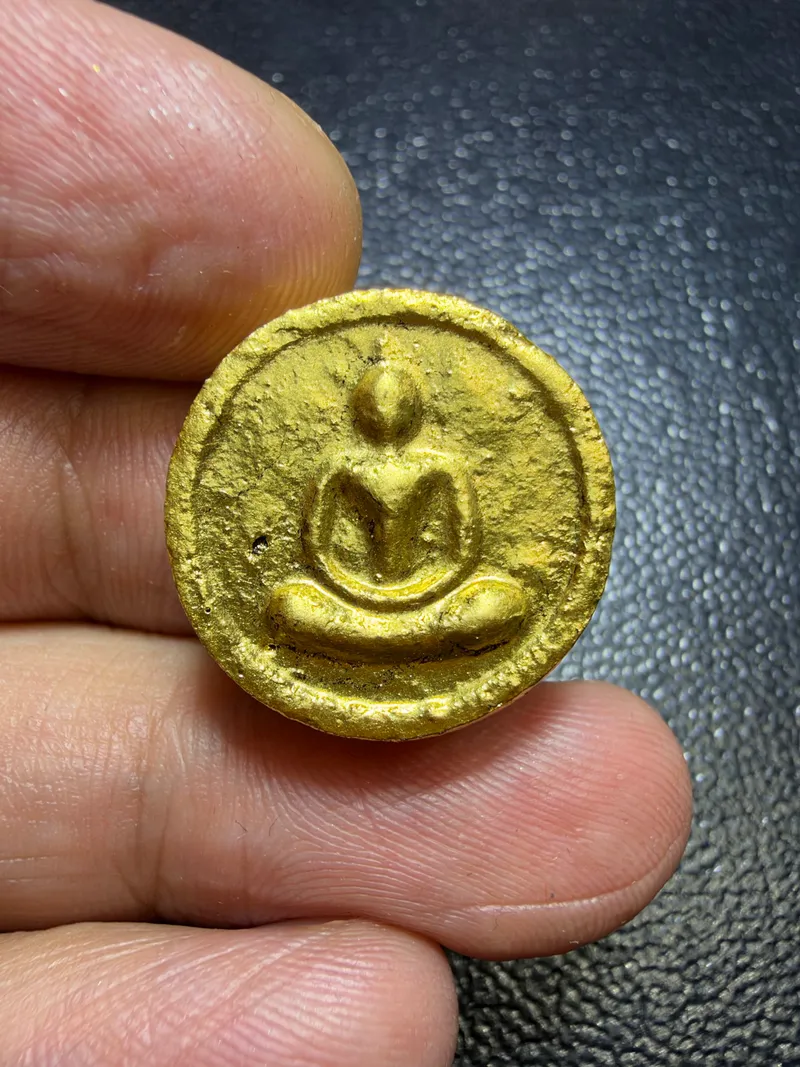
Phra Phong Chan Loi by Luang Phor Pae, first batch (พระผงจันทร์ลอยหลวงพ่อแพ รุ่นแรก เนื้อผง), powder, B.E. 2517, registered to Wat Pikun Thong (วัดพิกุลทอง), Sing Buri. Formal Association card no. P09735, barcode GJ10-676F4. One piece only. It is held by a partner supplier, so tap Hold this piece for me and we confirm availability by email within 24 hours.
What is the Chan Loi powder amulet of Luang Phor Pae?
จันทร์ลอย, Chan Loi, means floating moon, and among Thai amulets it names a small round piece shaped like a full moon. This is Luang Phor Pae’s Chan Loi in powder, registered to B.E. 2517 (1974), earlier than the Somdej batches of his that circulate most widely.
The Association website records it as พระผงจันทร์ลอยหลวงพ่อแพ รุ่นแรก เนื้อผง พ.ศ. 2517, class powder amulet (พระเนื้อผง), registered to วัดพิกุลทอง, สิงห์บุรี. รุ่นแรก means first batch. That is written in the registered name and is not something the supplier added.
The supplier’s title calls it a Chan Loi Somdej. Strictly, a Somdej is the rectangular form with the Buddha on a tiered base. This piece is round with no base, and the registered name uses พระผง, powder amulet, without the word สมเด็จ. We follow the registration.
One more thing the supplier’s text leaves out: the piece is gold in colour. The registered material is powder, and in the photos the gold is a coating over a darker ground. We cannot say whether it is gold leaf or gold paint, or whether it was there when the piece left the temple or was added by a later owner. The photo on the Association card shows gold on the piece as well, so there was already gold on it when it was examined; whether any was added afterwards cannot be told from photos.
Key facts
- Type: Phra Phong Chan Loi (พระผงจันทร์ลอย), round, seated Buddha on the front
- Batch: first batch (รุ่นแรก), as stated in the registered name
- Material: powder (เนื้อผง)
- Surface: gold-coloured coating, leaf or paint unknown, not tested; not confirmed as applied by the temple
- Year: B.E. 2517 (1974)
- Monk: Luang Phor Pae (หลวงพ่อแพ เขมังกโร)
- Source: Wat Pikun Thong (วัดพิกุลทอง), Sing Buri (สิงห์บุรี)
- Front: seated Buddha inside a raised rim, a small pit on the left
- Back: spired symbol above an arch-shaped yant, black specks where the coating is thin
- Case: none, sold uncased
- Certification: formal card of the Thai Buddha Image Admiration Association, no. P09735, barcode GJ10-676F4, issued 27 October B.E. 2569, verifiable on the Association website
- Stock: one piece, held by a partner supplier
About Luang Phor Pae
Luang Phor Pae Khemangkaro (หลวงพ่อแพ เขมังกโร) spent his monastic life at Wat Pikun Thong in Sing Buri. According to Thai sources he was born on 1 January B.E. 2448 (1 January 1906) in Ban Suan Kluai, Tha Chang district, Sing Buri, entered Wat Pikun Thong as a novice at sixteen and took full ordination on 21 April B.E. 2469 (1926). His final ecclesiastical title was Phra Tham Muni (พระธรรมมุนี), and he died in B.E. 2542 (1999). The supplier calls him the king of modern Somdej. That is how the supplier and some collectors speak of him, and we only report it.
What people wear it for
- Safety and protection from danger, as devotees believe
- Goodwill and helpful people
- Attracting wealth, in the traditional telling
- Smooth progress at work
These are devotional beliefs. An amulet does not guarantee any outcome.
Craftsmanship and condition
A small round amulet, held between two fingers in the photos and a little wider than a fingertip; the supplier gives no measurements. Seen from the side in the certificate photo it has real thickness, more a small disc than a wafer. Front, back and edge are all gold in colour, a warm yellow with a fine grainy matt texture and no mirror shine. A raised rim runs round the front, uneven in width and slightly wavy at the edge. Inside it sits the Buddha: an oval head coming to a slight point, no facial features, the body given only as an outline with broad shoulders, a narrow waist and a V at the chest, and the legs as a single band turned up a little at each end. There is no base. The drawing is spare and plain. On the left of the front, close to the rim, is a small black pit, with one or two smaller black specks below it. The darker ground under the coating shows in the hollow beneath the legs and along the inside of the rim. The same pit can be seen in the photo printed on the card. The back is essentially flat. At the top is a spired symbol with a point, a few curled turns and a stroke out to each side at its foot. Below it is an arch-shaped yant, like a doorway drawn in two or three lines, dipping at the centre of the top, with each foot and each inner line ending in a small circle. Around the yant, at the right edge and lower down there are scattered black specks and one short black scuff where the coating is thin or lost. The edge is uneven in places. No cracks or missing corners are visible in the photos. The piece is uncased.
FAQ
Q: How do I check the certification?
A: The last product image shows the formal Association card with the piece. It is the plastic card with a photo on a blue ground (บัตรรับรองพระแท้), no. P09735, barcode GJ10-676F4, issued 27 October B.E. 2569 (27 October 2026). Entering GJ10-676F4 on the Thai Buddha Image Admiration Association website returns class พระเนื้อผง, name พระผงจันทร์ลอยหลวงพ่อแพ รุ่นแรก เนื้อผง พ.ศ. 2517, registered to วัดพิกุลทอง, สิงห์บุรี. The QR code on the card can be scanned too.
Q: It is registered as powder. Why does it look gold?
A: The body is powder and the gold is a coating on the surface. From the photos we cannot tell gold leaf from gold paint, and we have not tested it. Nor can we confirm whether the coating dates from the temple or was added by a later owner. The supplier’s text does not mention it. What we can say is that the photo on the card already shows gold on the piece, so there was already gold on it when the Association examined it. The card photo looks darker and greyer than the photos of the piece itself, which we put down to lighting and printing; the small pit on the left of the front sits in the same place in both. If an original gilded surface matters to you, treat that point as unknown.
Q: What condition is it in?
A: A small pit near the rim on the left of the front with one or two black specks beside it, a few specks on the back and edge where the coating is thin and the dark ground shows, a short scuff on the right of the back, and a rim that is not perfectly regular. The Buddha and the yant are complete, and no cracks or missing corners are visible in the photos.
Q: The supplier calls it a Chan Loi Somdej. Why do you call it a powder amulet?
A: The registered name is พระผงจันทร์ลอย, Chan Loi powder amulet, and the word Somdej (สมเด็จ) is not in it. Somdej normally means the rectangular form with a tiered base, and this piece is round with no base. The supplier probably uses the word because Luang Phor Pae is best known for Somdej. When you check the record, go by the registered name.
Q: Is first batch documented? And why is the temple spelled differently by the supplier?
A: รุ่นแรก, first batch, is part of the registered name and appears when you look up the barcode on the Association website. As for the temple, the supplier’s Chinese listing uses a different transliteration, but both refer to วัดพิกุลทอง, Wat Pikun Thong, also romanised Wat Phikun Thong.
Q: Why do I ask you to hold it before paying?
A: This piece is held by a partner supplier rather than in our Bangkok stock. To avoid taking payment for a piece that has already sold, we confirm with the supplier first and reply by email within 24 hours, with a payment link valid for 24 hours if it is available. Asking us to hold it costs nothing.
About this piece
- Includes: one Phra Phong Chan Loi by Luang Phor Pae, first batch, in powder with a gold-coloured surface coating, uncased, with the formal Association card (no. P09735, barcode GJ10-676F4)
- Price: ฿7,000
- Stock: one piece
- How to buy: tap Hold this piece for me on this page and pay by the emailed link once availability is confirmed
Last updated: 2026-11-29 | Merit Messenger team, based in Bangkok