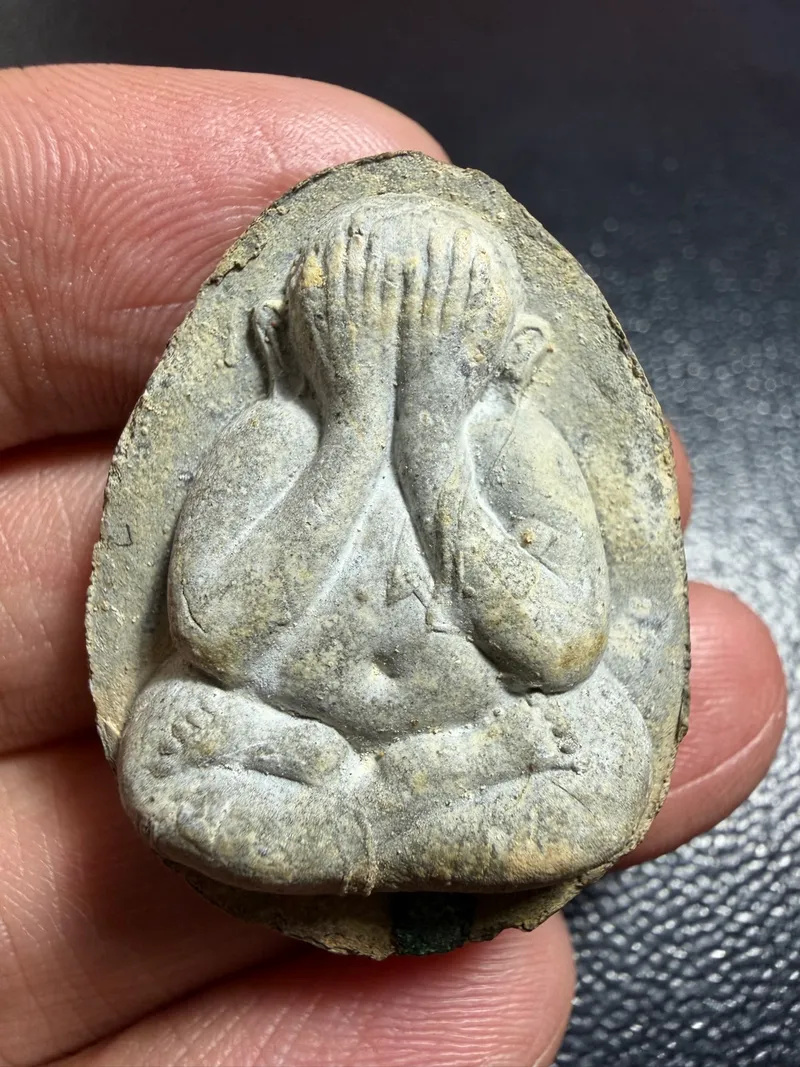
Luang Pu Toh Phra Pidta, Jumbo 2 large mould (พระปิดตาหลังยันต์สุกิตติมาหลวงปู่โต๊ะ พิมพ์ใหญ่ (จัมโบ้ 2) เนื้อผงใบลาน), palm-leaf powder, about B.E. 2521 to 2523 on the Association record and B.E. 2521 (1978) according to the supplier, registered to Wat Pradu Chimphli (วัดประดู่ฉิมพลี), Bangkok. Certificate GJ06-3D276. One piece only. It is held by a partner supplier, so please tap Hold this piece for me and we confirm availability by email within 24 hours.
What is the Jumbo 2 Phra Pidta?
Phra Pidta (พระปิดตา) is a seated figure covering its face with both hands, a sign of closing off the senses. Devotees wear it for wealth, for protection from danger and to stay clear of trouble. Luang Pu Toh Indasuvanno (หลวงปู่โต๊ะ อินทสุวัณโณ) was abbot of Wat Pradu Chimphli in Bangkok, a meditation monk whose best-known amulets are his Phra Pidta. Jumbo (จัมโบ้) is the collectors' name for his large ones: the B.E. 2520 group is called Jumbo 1, and the large mould registered to B.E. 2521 to 2523 is called Jumbo 2. They are different groups. ผงใบลาน is powder mixed with the ash of palm-leaf manuscripts, greyish in colour, and one of the usual materials of his Phra Pidta.
The Association records this piece as พระปิดตาหลังยันต์สุกิตติมาหลวงปู่โต๊ะ พิมพ์ใหญ่ (จัมโบ้ 2) เนื้อผงใบลาน ประมาณพ.ศ. 2521 - 2523: Luang Pu Toh Phra Pidta, Sukittima yantra back, large mould (Jumbo 2), palm-leaf powder, about B.E. 2521 to 2523, from Wat Pradu Chimphli in Bangkok. Monk, mould and powder agree with the supplier, and so do หลวงปู่โต๊ะ and the temple name pressed into the back. On the year, the record gives a range. The supplier states that the pieces were made in B.E. 2521 and that Luang Pu Toh kept them in his quarters and blessed them for three years before releasing them, which fits the range but is not on the record. These are also supplier statements: that this is the version soaked in holy water; that the powder includes Somdej powder, early Wat Paknam powder and hand-written yantra powder; and that a wearer survived a parachute failure. None has a source and none is treated as fact here. The product photo shows the Association's sealed box, which carries only the box number 07076 and the barcode number GJ06-3D276.
Key facts
- Type: Phra Pidta (พระปิดตา), powder amulet, egg-shaped
- Mould: large, Jumbo 2 (พิมพ์ใหญ่ (จัมโบ้ 2))
- Back: Sukittima yantra (ยันต์สุกิตติมา), a round grid, with หลวงปู่โต๊ะ and วัดประดู่ฉิมพลี
- Material: palm-leaf powder (เนื้อผงใบลาน); soaked in holy water according to the supplier, not on the record
- Year: about B.E. 2521 to 2523 on the record; B.E. 2521 (1978) according to the supplier
- Temple: Wat Pradu Chimphli (วัดประดู่ฉิมพลี), Bangkok
- Condition: several chips and rough spots on the thin rim; a small dark green fragment of unknown origin at the bottom edge; the figure and yantra are whole
- Case: none, uncased
- Certification: Thai Buddha Image Admiration Association, GJ06-3D276 (box no. 07076), verifiable on the Association website; the photo shows the sealed box, and the formal card ships with the piece
- Stock: one piece, held by a partner supplier
About Luang Pu Toh
Luang Pu Toh Indasuvanno (หลวงปู่โต๊ะ อินทสุวัณโณ), born B.E. 2430 (1887), passed away B.E. 2524 (1981), abbot of Wat Pradu Chimphli in Bangkok, known for meditation and for his Phra Pidta. The registered range of years falls within his lifetime.
What people wear it for
- Protection from danger and a way out of trouble
- Attracting and keeping wealth
- Staying clear of disputes and ill will
- A steady mind
These are devotional beliefs. An amulet does not guarantee any outcome.
Craftsmanship and condition
An egg-shaped powder amulet, slightly pointed at the top and broad and round below, domed on the front and gently swelling on the back. The front shows a Phra Pidta: both hands raised over the whole face with each finger cut separately, and an ear showing on either side of the hands. The arms are thick and round with the elbows out, the belly is full with a navel dot at its centre, and the legs are crossed with both soles turned up and the toes marked. A thin margin of ground runs around the figure. The powder is grey-white under a yellowish old tone, with earth-yellow patches in the recesses and along the edge. The condition needs stating plainly. The thin rim is uneven, with several chips and rough spots, most visible on the right and lower left of the front, and a notch on the right edge of the back. At the centre of the bottom edge, under the legs, a small dark green fragment is set into the powder; the photos do not show what it is, and it can also be seen in the photo of the sealed box. The figure itself is undamaged, with fingers, ears and toes all clear. The back carries a pressed yantra: a large circle whose outer ring is divided into cells and whose interior is ruled into a grid, with a Khom character in each cell. Above the circle หลวงปู่โต๊ะ follows the curve, and below it วัดประดู่ฉิมพลี; the lettering is legible, with some strokes shallow. No case.
FAQ
Q: How do I check the certification?
A: The photo shows the sealed box, whose barcode is the certificate number. Enter GJ06-3D276 on the Thai Buddha Image Admiration Association website to see the registered name พระปิดตาหลังยันต์สุกิตติมาหลวงปู่โต๊ะ พิมพ์ใหญ่ (จัมโบ้ 2) เนื้อผงใบลาน ประมาณพ.ศ. 2521 - 2523, registered to วัดประดู่ฉิมพลี (กรุงเทพมหานคร). The formal Association card ships with the piece.
Q: Why does the photo show a box instead of a card?
A: Once a piece is judged genuine the Association seals it in a box with a barcode label. The number under the barcode is the certificate number and can be looked up on the Association website. The formal plastic card is issued afterwards and ships with the piece.
Q: How serious are the chips?
A: They are all on the thin margin outside the figure, most visible on the right and lower left of the front and the right edge of the back, the usual kind of damage on the thin edge of a powder amulet. The figure and the yantra on the back are not damaged. The small dark green fragment at the bottom edge is of unknown origin; if it matters to you, write first and we will ask the supplier before replying.
Q: Which year is it?
A: The Association record says about B.E. 2521 to 2523, a range. The supplier states the pieces were made in B.E. 2521 and released after three years of blessing. The year field on this page follows the supplier, and the registered range is given alongside it.
Q: How does Jumbo 2 differ from Jumbo 1?
A: Jumbo 1 is the group made in B.E. 2520 for Luang Pu Toh's 90th year. Jumbo 2 is the collectors' name for the large mould registered to B.E. 2521 to 2523. They are different groups, and this piece is registered as Jumbo 2.
Q: Who is it for?
A: Collectors of Luang Pu Toh Phra Pidta, people seeking protection, and buyers who accept a chipped rim and value the Association record.
Q: Why do I ask you to hold it before paying?
A: This piece is held by a partner supplier rather than in our Bangkok stock. To avoid taking payment for a piece that has already sold, we confirm with the supplier first and reply by email within 24 hours, with a payment link valid for 24 hours if it is available. Asking us to hold it costs nothing.
About this piece
- Includes: one Luang Pu Toh Jumbo 2 large-mould palm-leaf powder Phra Pidta, uncased, with chips on the rim, with Association card GJ06-3D276
- Price: ฿160,000
- Stock: one piece only
- How to buy: tap Hold this piece for me on this page and pay by the emailed link once availability is confirmed
Last updated: 2026-11-24 | Merit Messenger team, based in Bangkok