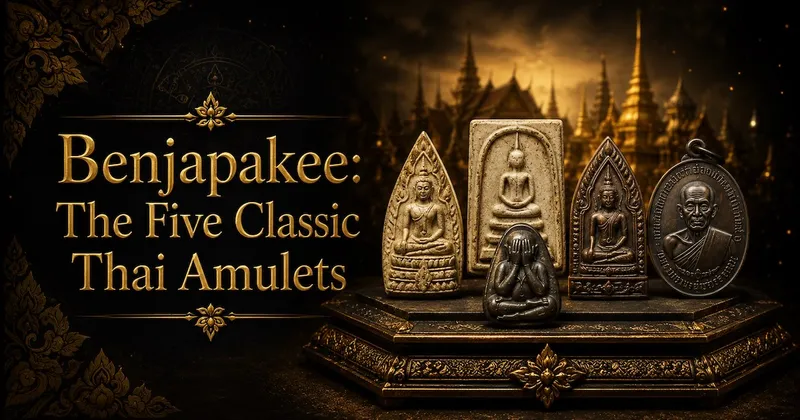
The Benjapakee (Thai: เบญจภาคี) is the supreme set in Thai amulet collecting: five classic amulets that define the top of the market — Phra Somdej of Wat Rakhang, Phra Rod of Lamphun, Phra Nang Phaya of Phitsanulok, Phra Phong Suphan of Suphan Buri, and Phra Sum Kor of Kamphaeng Phet. Together they span roughly a thousand years, from the Hariphunchai and Sukhothai kingdoms through Ayutthaya to nineteenth-century Bangkok. Understand the Benjapakee and you understand how the entire Thai amulet value system works.
Where the term comes from
Benjapakee derives from Pali: benja means five, pakee means group. The grouping was codified by mid-twentieth-century collectors — the connoisseur Triyampavai is usually credited — and has been the market's gold standard ever since. Note the distinction: the Benjapakee ranks amulets, while the Nine Great Monks convention ranks masters. The two intersect in Somdej Toh, creator of the set's leading piece.
The five amulets
1. Phra Somdej of Wat Rakhang — head of the set
Created in mid-nineteenth-century Bangkok by Somdej Phra Buddhacharn Toh of Wat Rakhang. A white sacred-powder tablet with a serenely minimal Buddha on a three-tier throne, revered as the King of Amulets: all-round fortune, patronage, and deliverance from harm. Top-condition originals trade in the tens of millions of baht. See our full Phra Somdej guide.
2. Phra Rod of Lamphun — the oldest
From Wat Mahawan in Lamphun, dating to the Hariphunchai kingdom roughly a thousand years ago — the most ancient of the five. The name Rod means to escape or survive, and the amulet's reputation follows: deliverance from mortal danger. Documented finds go back to the reign of Rama V. Read our profile of Phra Rod.
3. Phra Nang Phaya of Phitsanulok — the Queen of Amulets
An Ayutthaya-era clay tablet from Wat Nang Phaya, famous since a major discovery in BE 2444 (1901). Its soft triangular form earned it the title Queen of Amulets, counterpart to the Somdej's King. Powers lean toward charm, authority, and graceful resolution of conflict — traditionally favored by women and by those in politics and business.
4. Phra Phong Suphan of Suphan Buri — the U-Thong warrior
Unearthed in BE 2456 (1913) from the pagoda crypt of Wat Phra Si Rattana Mahathat in Suphan Buri, in the stern U-Thong artistic style. Its reputation is martial: invulnerability-grade protection and an aura of command.
5. Phra Sum Kor of Kamphaeng Phet — the final piece
A Sukhothai-era arch-shaped tablet from the old kilns of Kamphaeng Phet, gentle and ancient in character. Its fame is prosperity that endures — Thai collectors quote the saying attributed to it: "With me, you shall never be poor."
Collecting reality: how normal people engage
- Original excavated pieces are museum-grade: they circulate among elite collectors at prices from millions to over a hundred million baht, and authentication is expert work. Any bargain "original Benjapakee" should be treated as fake by default.
- The realistic entry is lineage editions: the original temples and their successor masters have issued commemorative and re-consecrated editions for decades — documented provenance at accessible prices.
- Value checklist: verifiable temple and year, recorded consecration ceremony, and a competition certificate or authentication card.
A common confusion: Khun Paen and Pidta
Neither belongs to the Benjapakee. The Khun Paen and Phra Pidta are equally iconic amulet types, but the Benjapakee bar is antiquity plus collector consensus. Different systems, different value logic — not a ranking of spiritual worth. For the full landscape of types, see Thai amulet types explained.
FAQ
Q: Can I actually buy a Benjapakee original?
A: Realistically no — originals trade within elite circles and auctions. Lineage editions from the same temples deliver the same tradition at hundreds rather than millions of baht.
Q: Which piece should a newcomer start with?
A: The Phra Somdej. It leads the set, is best documented, and has the widest choice of legitimate successor editions.
Q: How does the Benjapakee relate to the Nine Great Monks?
A: One ranks amulets, the other ranks masters. Somdej Toh appears in both — as creator of the Phra Somdej and as one of the nine.
Last updated: July 2026 | By the Merit Messenger team, based in Bangkok
Looking for documented Somdej lineage pieces? Browse our collection or contact us — every amulet lists its temple and authentication details.