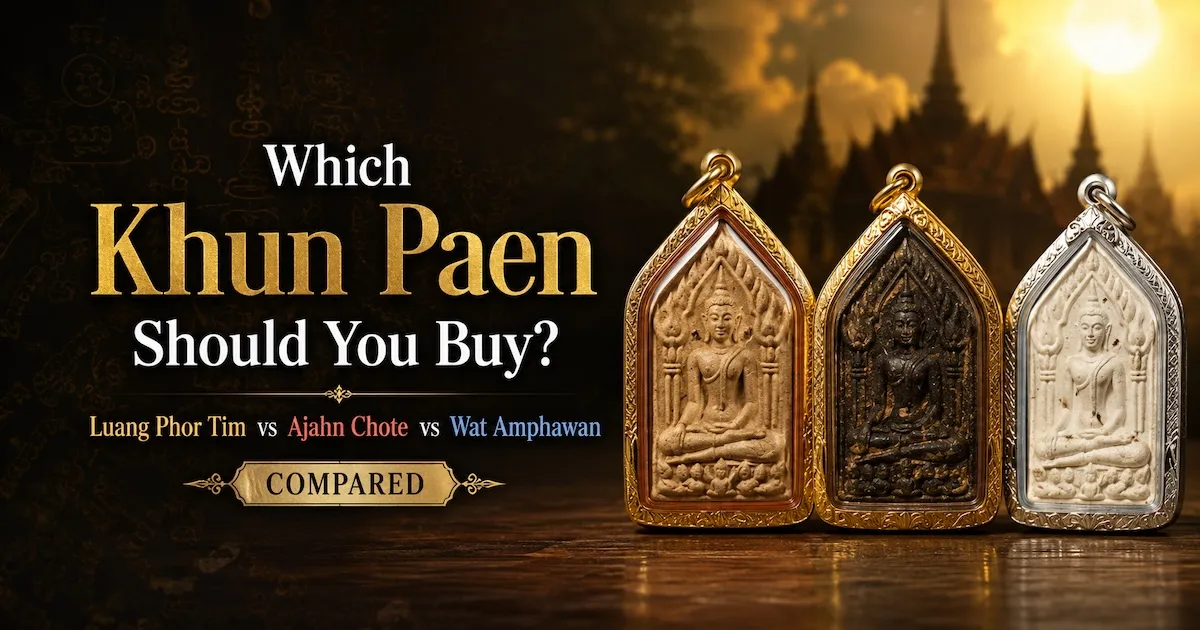
Khun Paen is the most popular charm amulet in Thailand — and the most confusing to buy. The same name covers pieces ranging from museum-grade antiques worth more than a car to accessible temple issues under a hundred dollars, made by masters with completely different reputations and methods. This guide compares the major Khun Paen traditions a buyer will actually encounter — Luang Phor Tim of Wat Lahan Rai, Ajahn Chote of Wat Phutthaisawan, and Luang Phor Jaran of Wat Amphawan — and gives a straightforward way to decide which fits you. If you are new to the form itself, start with our complete Khun Paen guide.
What all Khun Paen share
Named after the warrior-lover of the Thai national epic, Khun Paen amulets are associated with metta mahaniyom (loving-kindness and popularity) and mahasaneh (personal magnetism) — qualities sought for romance, social ease, sales, and negotiation. The classic form is a five-sided frame around a seated Buddha. Where versions differ is in the master, the era, the powder, and whether spirit materials (prai) are involved.
Luang Phor Tim, Wat Lahan Rai: the collector benchmark
The Khun Paen Prai Kuman of Luang Phor Tim Attasanti (Rayong) from the B.E. 2515 era is the most famous — and most faked — Khun Paen line in existence. Genuine examples trade at collector prices and effectively define the top of the market. Our Luang Phor Tim Khun Paen guide covers the history and the authentication minefield. The practical takeaway for most buyers: unless you are working with certified pieces and serious budget, treat this line as something to study rather than to hunt casually — the fake ratio is unforgiving.
Ajahn Chote, Wat Phutthaisawan: the accessible royal-temple entry
At the opposite end of accessibility sits the Khun Paen Jom Khon ("king of men" mould) by Ajahn Chote, consecrated in B.E. 2550 at Wat Phutthaisawan — the royal old temple in Ayutthaya, the very city of the Khun Paen legend. Made of sacred powder, supplied with a certificate, and restockable, it is the piece we recommend to first-time Khun Paen buyers: correct form, documented royal-temple ceremony, and a price that does not require collector conviction. Ajahn Chote's wider work is profiled in our Ajahn Chote guide.
Luang Phor Jaran, Wat Amphawan: the meditation-lineage alternative
The glazed Khun Paen (B.E. 2556) from Wat Amphawan is a different proposition: a one-of-a-kind clay piece from a temple famous for vipassana meditation rather than charm magic. It contains no prai materials, which matters to buyers who want the Khun Paen form and meaning without the spirit-material controversy. It suits people who value the consecrating master's meditation pedigree over charm-lineage fame.
Choosing in one pass
- First Khun Paen, modest budget: Ajahn Chote Jom Khon — correct, certified, restockable.
- No spirit materials on principle: the Wat Amphawan glazed piece.
- Collector ambition: study the Luang Phor Tim line first, buy only certified, and read our authentication guide before spending.
Whichever you choose, browse the romance and charm collection for alternatives, and remember that Khun Paen rewards confident, sociable wear — it amplifies presence rather than replacing it.
Frequently asked questions
Is Khun Paen only for romance?
No. Its magnetism tradition is equally valued in sales, service work, and leadership — any field where being liked moves results.
Can women wear Khun Paen?
Yes. The charm works the same way; choose a size that wears comfortably and follow ordinary amulet etiquette.