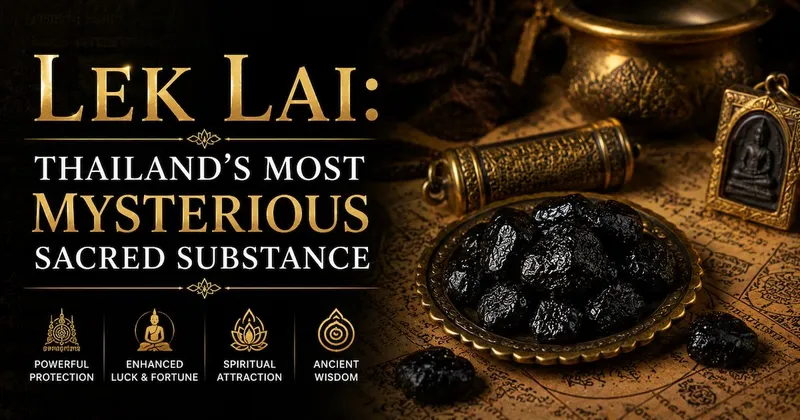
What Is Lek Lai?
Lek Lai is the most enigmatic substance in Thai Buddhist spiritual tradition — a rare, naturally occurring material found in caves and remote mountain locations that is believed to possess extraordinary supernatural properties. The name translates roughly as "flowing metal" or "liquid iron," referring to the traditional belief that Lek Lai can change its physical state, moving through solid rock and reshaping itself under the right spiritual conditions.
For Thai amulet practitioners, genuine Lek Lai represents the ultimate protective material — a substance so inherently powerful that it does not require a monk's consecration to carry spiritual energy, though consecrated Lek Lai is considered even more potent.
Types of Lek Lai
Thai tradition recognizes multiple varieties, each with different properties and appearances:
- Lek Lai Nam Neung (type one) — The rarest and most prized variety. Dark, dense, with a metallic sheen. Said to be virtually indestructible and possessing the strongest protective energy.
- Lek Lai Thong (golden) — A variety with golden or amber coloration, associated with wealth attraction in addition to protection.
- Lek Lai Ngern (silver) — Silver-colored variety, associated with Metta energy and social harmony.
- Lek Lai Khao (white) — Lighter colored, associated with spiritual purification and clarity.
- Lek Lai Dam (black) — Deep black variety, considered the most powerfully protective.
In practice, the term "Lek Lai" is applied to various naturally occurring mineral formations found in cave environments — some genuinely unusual, others more ordinary minerals marketed under the Lek Lai name. Distinguishing authentic Lek Lai from common minerals requires expertise.
How Lek Lai Is Found
According to tradition, Lek Lai cannot simply be mined or collected casually. It must be located by a monk or master with the spiritual attainment to sense its presence, typically in deep caves in remote mountain areas. The extraction process is itself a spiritual ritual:
- The monk enters a deep meditative state and calls the Lek Lai to reveal itself
- Fire and chanting are used to coax the substance from the cave walls
- The Lek Lai is said to respond to the spiritual energy of the practitioner — it will not yield to those with insufficient spiritual cultivation
- Once extracted, it is further consecrated and formed into amulets or protective pieces
Whether one takes this account literally or metaphorically, the ritual process ensures that any Lek Lai handled by a genuine master has been deeply imbued with spiritual energy through intensive practice.
Protective Properties
Lek Lai is primarily associated with the most powerful forms of protection:
- Kong Grapan Chadtri (invulnerability) — Lek Lai is considered the strongest material for physical protection in the entire Thai tradition. Stories of Lek Lai stopping bullets and deflecting knives are common in Thai spiritual literature.
- Klaew Klaad (danger evasion) — Beyond physical protection, Lek Lai is believed to create an energy field that redirects danger away from the wearer entirely.
- Anti-poison — Traditional belief holds that Lek Lai can neutralize poisons and venoms — a property that reflects its origin in cave environments shared with venomous creatures.
- Spiritual sensitivity — Lek Lai is said to react to spiritual energy, becoming warm in the presence of genuine spiritual power and cold in neutral environments.
Lek Lai in Amulet Form
Lek Lai is incorporated into Thai amulets in several ways:
- Standalone pieces — Small pieces of Lek Lai encased in waterproof or metal frames, worn as pendants
- Mixed into amulet materials — Lek Lai fragments ground and mixed into the sacred powder of amulets, adding its protective energy to the consecrated blend
- Inserted into Takrut — Small pieces placed inside the rolled metal scrolls of Takrut for enhanced protection
- Home protection — Larger pieces placed in the home for spiritual shielding of the living space
Authenticity Challenges
Lek Lai is perhaps the most counterfeited category in the Thai amulet market. Because the material is naturally occurring and not standardized, almost any dark, dense mineral can be labeled as Lek Lai by unscrupulous sellers. Common substitutes include industrial slag, resin, dyed minerals, and ordinary cave formations.
To reduce risk:
- Buy only from dealers who can identify the specific monk who sourced and consecrated the piece
- Be skeptical of cheap Lek Lai — genuine pieces from reputable monks are not commonly available at bargain prices
- Focus on the monk's reputation rather than the material's appearance — a consecrated piece from a respected master is valuable regardless of whether it meets every traditional Lek Lai criterion
A Balanced Perspective
Lek Lai sits at the boundary between verified tradition and unverifiable claim. The spiritual practices surrounding its collection and consecration are genuine and documented. The specific material properties attributed to it are matters of faith. For practitioners, what matters most is the spiritual intention and consecration quality behind the piece, not whether the material passes a geological test.
Explore our collection for protection-focused amulets, or learn more about Thai amulet materials broadly. For other powerful protection options, see our guides to Phra Pidta and Takrut scrolls.